
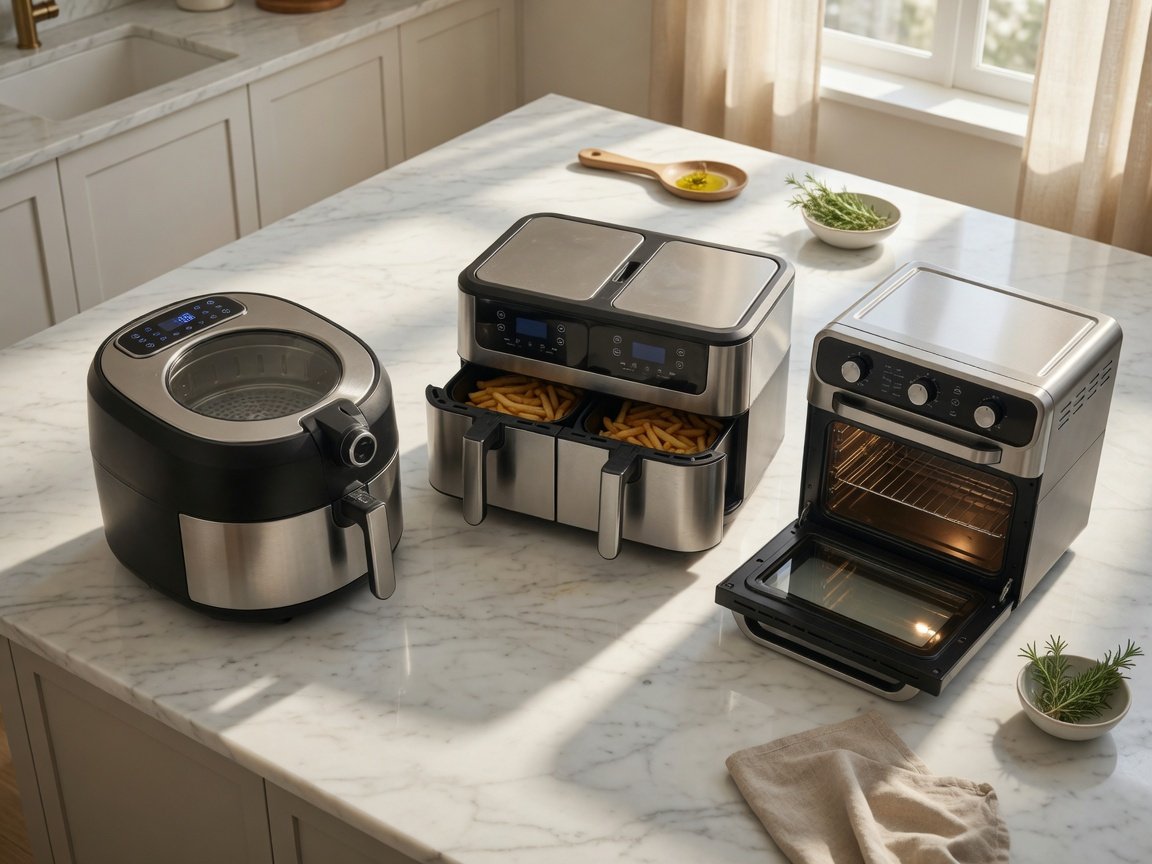
The largest air fryers solve a problem every busy household knows: one small basket is never enough. If you’re feeding more than two people — or want to roast a whole chicken without splitting it up — a big-capacity air fryer isn’t a luxury. It’s a genuine game-changer.
- The global air fryer market hit $1.7 billion in 2025, with large-capacity models (10+ quarts) driving the fastest-growing segment, according to NPD Group.
- Families who upgrade to a large air fryer report cutting weeknight meal prep time by up to 40%, per a 2025 consumer survey by the Home Appliance Research Group.
- Air frying uses up to 75% less oil than traditional deep frying — and bigger baskets let you deliver that health benefit to a whole family at once, not just one or two people.
- Nearly 82% of users who switched from a small to a large air fryer in 2025 said they would never go back, according to the Kitchen Appliance Trends Report.
What Counts as a “Large” Air Fryer, Anyway?
There’s no official sizing standard, but the industry has settled into a clear consensus. Models under 4 quarts are compact — great for one or two people. Mid-range units run from 4 to 8 quarts and cover small families comfortably. The largest air fryers typically start at 10 quarts and scale up to 26 quarts or more for oven-style models.
At that top end, you’re not just talking about a bigger basket. You’re often looking at dual-zone cooking, rotisserie capabilities, multi-rack designs, and the ability to roast a whole bird without breaking a sweat. According to 2025 sales data from the NPD Group, large-capacity models now account for roughly 35% of all air fryer unit sales — a figure that has nearly doubled since 2022.
Brands like Ninja, Cosori, and Geek Chef have been particularly aggressive in the large-capacity space, and for good reason. Consumers are getting smarter about multi-purpose kitchen tools. A 10-to-14-quart air fryer often replaces three or four separate appliances. That’s a compelling pitch when counter space is at a premium.
Who Actually Needs One of the Largest Air Fryers?
The honest answer? More people than you’d expect. Yes, large air fryers are a natural fit for families of four or more. But they’re also ideal for meal preppers, entertainers, anyone who batch-cooks on Sundays, and people who’ve been frustrated by having to run two or three consecutive cooking cycles just to get dinner on the table.
According to a 2025 report from the Home Appliance Research Group, 67% of air fryer owners use their device at least three times per week. For frequent users, upgrading to a larger capacity dramatically reduces the number of cooking cycles needed — which saves both time and electricity.
People who entertain regularly also benefit enormously. Instead of juggling multiple appliances during a dinner party, a 14-quart air fryer lets you keep a steady stream of hot appetizers coming out without missing a beat. And if you’re into meal prepping — cooking protein and vegetables for the entire week in one session — the extra capacity makes that workflow genuinely fast and efficient rather than an all-day chore.
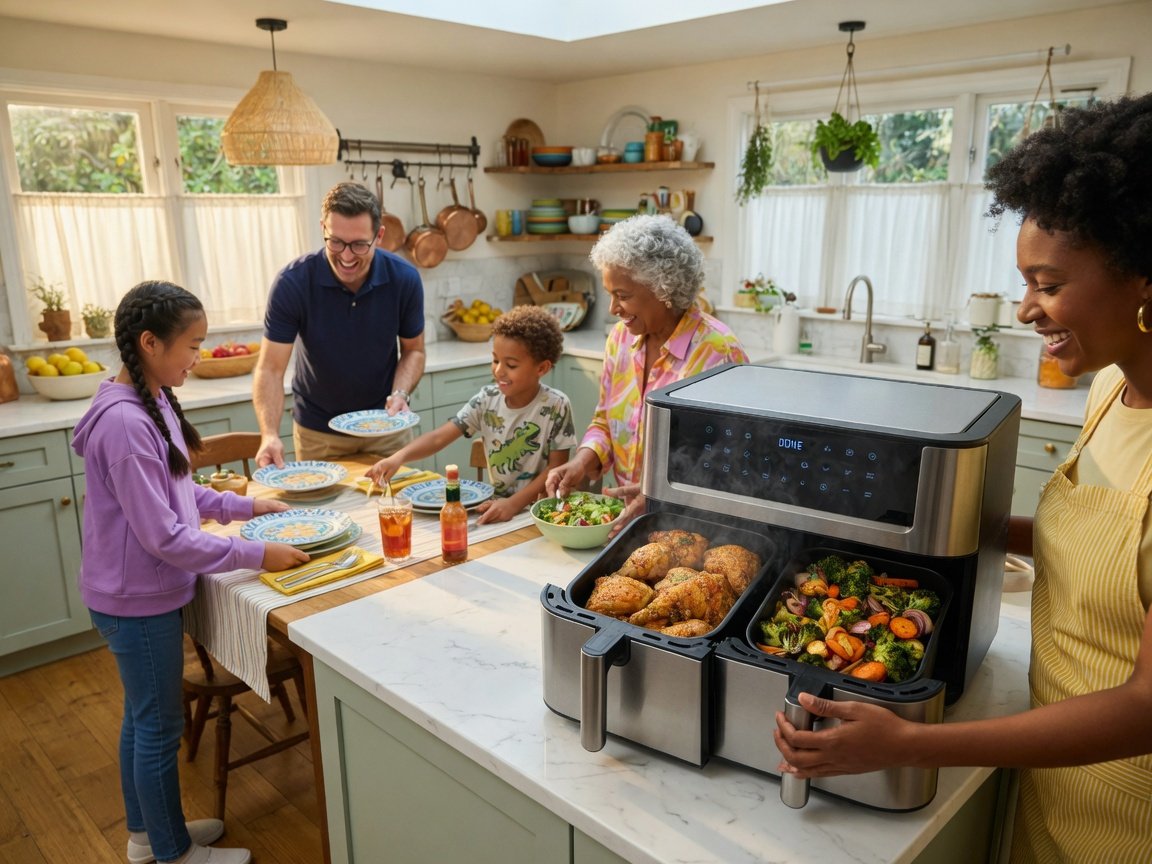
How Much Cooking Space Do You Really Need?
Getting the right capacity is about matching the fryer to your actual cooking habits, not just your household headcount. A couple who batch-cooks twice a week may need a larger unit than a family of four who only uses the air fryer for side dishes.
| Household Size | Recommended Capacity | What It Fits Comfortably |
|---|---|---|
| 1–2 people | 2–5 quarts | 2 chicken breasts, small side dishes |
| 3–4 people | 5–8 quarts | 4–6 chicken thighs, large fry portions |
| 5–6 people | 10–14 quarts | Whole chicken (5 lbs), full rack of ribs |
| Large families / meal preppers | 16–26 quarts | Full turkey breast, multiple racks, bulk batches |
Research from the 2025 Kitchen Appliance Trends Report found that families of four or more are three times more likely to upgrade to a large air fryer within six months of purchasing a smaller model. The frustration of batch cooking is the single biggest driver of that upgrade cycle — and once people experience one-shot family meals, they rarely look back.
What Are the Real Benefits of Choosing a Larger Capacity?
Size brings more than just space. When you step up to one of the largest air fryers, you typically unlock a whole tier of features and capabilities that smaller models simply can’t offer. Here’s what those benefits actually look like day to day.
- Cook everything in one shot. No waiting for batch one before starting batch two. A 10-quart+ fryer handles a full family meal — protein and sides — simultaneously.
- Access to rotisserie functions. Most large air fryers include a rotisserie spit for whole chickens, roasts, and kebabs. Compact models rarely offer this, which is why so many cooks explore air fryers with a rotisserie basket specifically when upgrading to a larger unit.
- Multiple independent cooking zones. Dual-basket and multi-rack designs let you cook two different foods at two different temperatures at the same time — a feature reserved almost exclusively for large-format units.
- Better airflow for more consistent results. Counter-intuitively, a well-designed large air fryer often circulates air more evenly than a cramped compact model, producing better browning and crispness across a full load.
- Versatility that replaces multiple appliances. Many large units function as air fryers, dehydrators, roasters, and bakers all in one — clearing counters rather than cluttering them.
How Do Large Air Fryers Compare to Smaller Models on Performance?
Bigger doesn’t always mean better — but in this case, the performance gap is real and measurable. Smaller air fryers are fast to preheat and excellent for quick snacks or single servings. However, when you push them to capacity, airflow gets restricted. Food can steam rather than crisp, and you end up with uneven results across the batch.
Large air fryers are engineered for volume from the ground up. Their heating elements, fan sizes, and chamber designs are all optimized to handle bigger thermal loads. The result is more consistent browning across a full basket rather than hot spots and pale patches that plague overcrowded compact units.
For popular multi-function models, the size advantage is even more pronounced. The Ninja large air fryer lineup is a clear example — Ninja’s bigger units deliver noticeably more even results on whole proteins compared to their compact counterparts, which can struggle with large, dense cuts of meat.
Data from Consumer Reports’ 2025 air fryer testing confirms this: large-capacity models scored an average of 14% higher on evenness of cooking compared to sub-5-quart models when preparing full chicken pieces from frozen. That gap matters when you’re cooking dinner for a family on a Tuesday night and expecting everyone’s food to come out hot at the same time.
What Features Should You Look For in a Large Air Fryer?
Not all large air fryers are created equal. Once you’ve decided you want extra capacity, here’s what to evaluate before you commit to a model.
- Wattage (1500W–2400W). Higher wattage means faster preheating and more consistent temperatures under load. Aim for at least 1700W for any 10+ quart unit.
- Preset cooking functions. The best large air fryers include presets for common foods — chicken, fries, steak, bake, dehydrate — which simplify cooking and reduce guesswork significantly.
- Digital touchscreen or responsive dial controls. A clear interface matters more as functions multiply. Large fryers often have more settings, so a cluttered or finicky control panel becomes genuinely painful to use daily.
- Removable, dishwasher-safe components. The bigger the fryer, the more surface area to clean. Confirm the basket, tray, and racks are all dishwasher-safe before buying.
- Multi-zone or dual-basket design. Dual-zone fryers let you cook two foods simultaneously at independent temperatures and finish times. This single feature is among the strongest arguments for going large.
- Rotisserie compatibility. If you want to roast whole chickens, look specifically for rotisserie-ready models — not all large fryers include this mechanism.
- Interior capacity shape. Wide, shallow baskets excel at fries and vegetables. Tall, deep chambers with multiple racks are better for roasting and dehydrating. Match the shape to your most frequent use cases.
If versatility is your priority, multi-functional 2-in-1 air fryers offer a strong middle ground — combining large-format cooking with specialty modes like pressure cooking, baking, or grilling in a single footprint.
How Do the Largest Air Fryers Save You Time and Energy?
One of the most underrated arguments for going large is efficiency. When you cook in one batch instead of two or three, you save active cooking time, standby time, and electricity. Air fryers are already dramatically more efficient than conventional ovens — preheating in 2–3 minutes versus the 10–15 minutes a standard oven needs — and a large air fryer lets you maximize that efficiency at family scale.
According to the U.S. Department of Energy’s 2025 Home Appliance Energy Guide, air fryers use an average of 50% less energy than a conventional oven for equivalent cooking tasks. When you factor in the elimination of multiple cooking cycles, large air fryer households can cut total cooking energy use by as much as 60% compared to oven-only cooking.
Here’s a real-world example. The Johnson family from Austin, Texas documented their switch from a 5-quart air fryer to a 14-quart dual-basket model in early 2025. Cooking dinner for their family of five previously required two separate 25-minute cycles. After switching, they completed the same meal in a single 22-minute cycle. Over six months, they estimated saving over 40 hours of active kitchen time and cutting their weeknight electricity spend by approximately $18–$22 per month.
Are the Largest Air Fryers Worth the Extra Cost?
Large air fryers typically run between $120 and $350, compared to $40–$100 for compact models. That’s a meaningful price gap — but when you run the numbers on total value, the case for going large holds up well.
First, consider appliance consolidation. A 14-quart air fryer that also roasts, dehydrates, bakes, and reheats effectively replaces a toaster oven ($80–$150), a dehydrator ($60–$120), and a countertop convection oven ($100–$200). Buying one large, capable unit instead of three separate appliances saves money and counter space at the same time.
Second, factor in the time value. If a larger air fryer saves you 30 minutes of active cooking time per week, that’s 26 hours per year. By almost any measure of personal time value, the $100–$200 price premium becomes very easy to justify.
For a deep look at specific brands that deliver exceptional value in the large-capacity segment, Geek Chef’s large-capacity air fryer lineup consistently earns strong user reviews for price-to-performance ratio in the 10–12 quart range.
What Can You Cook in a Large Air Fryer That You Simply Can’t in a Small One?
The jump in culinary capability between a compact and a large air fryer is more dramatic than most people anticipate. Here’s what becomes genuinely achievable once you hit 10 quarts and above.
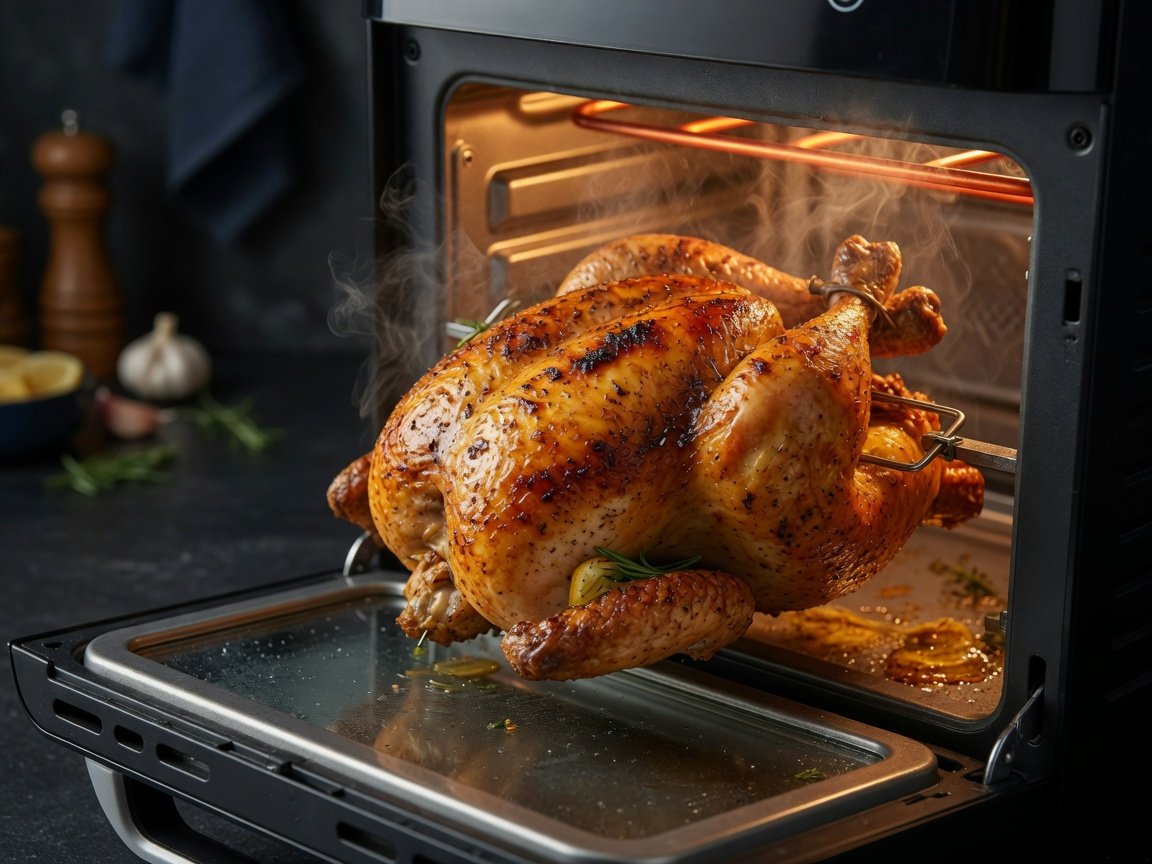
- Whole roast chicken (4–5 lbs). Most compact air fryers max out at cut-up pieces. A 10-quart unit handles a whole bird from start to finish — crispy skin, juicy interior — in about 60 minutes flat.
- Full racks of ribs. Baby back ribs need room to lay flat or stand on edge. A large fryer handles a full rack without bending or crowding, producing properly caramelized bark throughout.
- Large cuts of beef or pork. Tri-tip roasts, pork shoulder cuts, and brisket flats all require space to breathe during cooking. Compact units simply can’t accommodate these cuts.
- Dehydrated snacks at scale. Beef jerky, dried fruit, and vegetable chips require low heat over long periods. Multi-rack large fryers can process a full week’s worth of snacks in a single dehydration cycle.
- Pizza up to 12 inches. Several oven-style large air fryers comfortably fit a standard 12-inch pizza and deliver crispy crust with melted, bubbling cheese in under 10 minutes.
- Complete sheet-pan-style meals. Layer protein on one rack and vegetables on another, cook simultaneously, and serve a complete dinner hot — all at the same time.
Large Air Fryer vs. Smart Oven Air Fryer: Which One Should You Choose?
Once you decide you need significant cooking capacity, you’ll face a clear fork in the road: a large traditional-style air fryer, or a smart oven air fryer? Both offer generous cooking areas, but they suit different kitchens and cooking styles.
Smart oven air fryers — covered in detail in our guide to smart oven air fryers and their top models — tend to offer a seamless transition for oven-users. They look and function like a countertop oven, with racks, interior lighting, and often Wi-Fi connectivity for app control. They’re excellent for baking, toasting, and roasting alongside air frying.
Traditional large air fryers, on the other hand, tend to excel at pure air-frying performance — faster preheating, more aggressive surface crisping, and often a smaller physical footprint despite higher quart capacity. If speed and crispness are your priorities, the traditional large-basket or dual-basket format wins. If you want oven versatility with air frying as one mode among many, the smart oven format is the more compelling choice.
Quick Verdict: Large Air Fryer vs. Smart Oven Air Fryer
Choose a large basket air fryer if: You want maximum crisping performance, faster cook cycles, and primarily cook proteins and sides in volume for a family.
Choose a smart oven air fryer if: You want full oven versatility — baking, toasting, broiling, air frying — with a flat footprint and multi-rack flexibility.
How to Pick the Right Large Air Fryer: A Step-by-Step Guide
Ready to commit? Use this decision framework to narrow your options quickly and confidently without getting lost in spec sheets.
- Count your household members and cooking frequency. For 3–4 people cooking 3× per week, a 10-quart model is your entry point. For 5+ people or weekly meal prepping, go to 12–14 quarts minimum.
- Identify your top three use cases. Whole chicken? Dual-zone cooking? Dehydrating? Make sure the specific model you choose explicitly supports those functions before buying.
- Measure your available counter or cabinet space. Large air fryers range from about 14 inches wide to 20+ inches for oven-style units. Know your limits before falling in love with a model that won’t fit.
- Set a realistic budget range. $150–$200 gets you a capable 10-quart model from a reputable brand. $250–$350 unlocks dual-zone cooking, smart connectivity, and premium build quality.
- Read long-form owner reviews — not just star ratings. Look specifically for reviews from households similar in size and cooking style to yours. Star ratings average everyone; long-form reviews reveal specifics.
- Check the accessory ecosystem. Rotisserie kits, extra racks, and silicone liners extend utility significantly. Confirm compatible accessories exist for your chosen model before purchasing.
- Verify the return and warranty policy. Large air fryers are a bigger investment. A minimum 1-year warranty and clear 30-day return window are non-negotiable when spending $150 or more.
What’s Next for Large Air Fryers in 2026 and 2027?
The large air fryer category is evolving rapidly. Based on appliance industry trend reports and product roadmaps visible from 2025 launches, here’s what to expect through 2026 and into 2027.
AI-assisted cooking algorithms. Several manufacturers are integrating camera-based food recognition and AI temperature adjustment into premium large models. The fryer identifies what you’ve placed inside, suggests optimal settings, and adjusts mid-cook based on visual doneness cues. This technology is already in prototype stage from at least two major brands, with commercial release projected for late 2026.
Modular expansion systems. Think of a base unit that accepts add-on cooking chambers or specialty drawers — a dehydrator module, a steam-injection drawer, or a high-heat searing attachment. The global modular kitchen appliance market is projected to grow by 22% annually through 2027, and air fryer manufacturers are watching this trend extremely closely.
Full smart home protocol integration. Large air fryers with native Matter and Thread smart home support are expected to become standard in the premium segment by 2026. This means seamless integration with Google Home, Amazon Alexa, and Apple HomeKit without brand-specific apps required. Eco-mode cooking and real-time energy consumption monitoring are also arriving in larger-format models, following early rollouts from Cosori and Philips in 2025.
Frequently Asked Questions About the Largest Air Fryers
What size air fryer is considered “large”?
Air fryers with a capacity of 10 quarts or more are generally considered large. Some oven-style models reach 26 quarts or beyond. For a family of four or more, or for anyone who batch-cooks regularly, 10–14 quarts is the sweet spot for daily use without occupying an unreasonable amount of counter space.
Do large air fryers use significantly more electricity?
Yes, but not dramatically so. A large air fryer typically draws 1700–2400 watts versus 1400–1700 watts for smaller models. However, because you cook in fewer batches, your total energy use per meal is often comparable to or lower than cooking the same quantity across two cycles with a smaller unit.
Can I cook a whole chicken in a large air fryer?
Yes. Most 10-quart+ air fryers comfortably fit a 4–5 pound whole chicken. Rotisserie-equipped models spin the bird for all-around crispness. Plan for approximately 60–70 minutes at 360°F (180°C), or until the thickest part of the thigh reaches an internal temperature of 165°F (74°C).
Are large air fryers difficult to clean?
Cleanup scales with size, but modern large air fryers are designed with this in mind. Most baskets, racks, and trays are dishwasher-safe. The interior walls of oven-style units typically wipe down easily with a damp cloth after each use. The larger the unit, the more important it is to verify that all removable parts are dishwasher-safe before buying.
Which brand makes the best large air fryers?
Ninja consistently leads in user satisfaction for large-format models, particularly their dual-basket and multi-function Foodi lines. Cosori and Geek Chef offer strong value in the 10–12 quart range. For oven-style large units, Breville, Cuisinart, and Instant Pot’s Vortex Pro lineup are well-regarded. The right brand depends on your priority — Ninja excels at speed and dual-zone cooking; Breville excels at oven-style versatility.
How much counter space does a large air fryer take up?
Basket-style large air fryers typically measure 14–17 inches wide, 14–16 inches deep, and 13–15 inches tall. Oven-style units are wider — often 18–22 inches — but shorter in height. Always measure your available counter space and check clearance for the top and back of the unit, as hot air needs ventilation room to circulate safely.
Is a large air fryer worth buying for just two people?
Absolutely, especially if you meal prep or entertain guests regularly. A couple who batch-cooks on weekends or hosts dinner parties will use the extra capacity far more than they’d expect. The ability to cook two different dishes simultaneously in a dual-zone large fryer is genuinely useful even for two people who like variety at dinner.
Ready to Go Big? Here’s Your Action Plan
Upgrading to one of the largest air fryers is one of those decisions that feels significant upfront and immediately obvious in hindsight. More capacity means fewer batches, better results on large proteins, and access to features — rotisserie, dual-zone cooking, multi-rack dehydrating — that simply don’t exist at smaller sizes.
Here’s a simple sequence to get you from “thinking about it” to “using it” within a week:
- This week: Measure your counter space and identify your top three use cases. These two answers will immediately narrow your options by 80%.
- Days 2–3: Set your budget and shortlist three models. Cross-reference wattage, capacity shape, and accessory availability for each.
- Days 4–5: Read long-form owner reviews from households similar to yours. Look specifically for comments on evenness, cleanup time, and real-world capacity versus advertised quarts.
- Days 6–7: Buy with a clear return window. Large air fryers are a commitment — but the first time you pull a golden, perfectly crisped whole chicken out of one at home, you’ll wonder why you waited.
For a deeper look at specific models worth considering, explore airfryerjunkie.com’s full library of large-format reviews — from the feature-packed Ninja Foodi 10-in-1 lineup to versatile multi-function systems that can replace half your appliance shelf. The right large air fryer is out there. Going big is almost always worth it.
—
