
The craziest thing you can cook in an air fryer? A full, creamy cheesecake — without a water bath. But that’s barely the start. From fried ice cream to whole roast chicken in under 40 minutes, air fryers have quietly become the most versatile appliance in any kitchen, and most people have barely scratched the surface of what they can do.
Key takeaways from this guide:
• Air fryers can bake, roast, dehydrate, and fry without oil — far beyond chips and frozen nuggets
• A whole 4-lb chicken cooks in roughly 35–38 minutes in an air fryer, compared to 90+ minutes in a conventional oven
• Industry analysts project the global air fryer market to exceed $1.5 billion in 2026, driven by versatility over health messaging alone
• Over 40% of US households now own an air fryer, yet most use it only for reheating and frozen foods
• Success with wild recipes comes down to three things: basket size, temperature control, and knowing when to use a parchment liner
Why Do Air Fryers Keep Surprising Everyone?
The original pitch for air fryers was simple: healthier chips, less oil. Nobody expected the thing to become a serious cooking appliance. Yet here we are in 2026, with home cooks making cheesecakes, roasting whole chickens, baking bread, and dehydrating fruit in a machine originally sold as a glorified chip maker.
The reason is physics. An air fryer is a compact convection oven with a radically more powerful fan. That fan circulates hot air at high velocity inside a small enclosed space, creating a dry, intense heat that strips moisture from food surfaces roughly 30–40% faster than a conventional oven does. The result: crispy exteriors, moist interiors, and cook times that regularly come in 25–30% faster than oven equivalents. Food scientist and author J. Kenji López-Alt has documented this convection effect extensively, noting that rapid-circulation cooking explains why air fryers produce fry-like textures without oil immersion — the physics are functionally similar to a commercial fry station, just without the liquid fat.
According to industry analysts, the global air fryer market has grown at a compound annual rate of around 7% since 2021 and is projected to exceed $1.5 billion in 2026. But that growth isn’t primarily a health story anymore. It’s a versatility story. People who bought an air fryer for chips stayed for the creative cooking, and the experiment has not stopped expanding since.
Most people start with something low-stakes — perfectly crispy tater tots in 12 minutes is the kind of gateway moment that makes people realise the machine is doing something genuinely different from a microwave — and then the curiosity kicks in. The question stops being “what can I cook in an air fryer?” and starts being “what actually can’t I cook in one?”
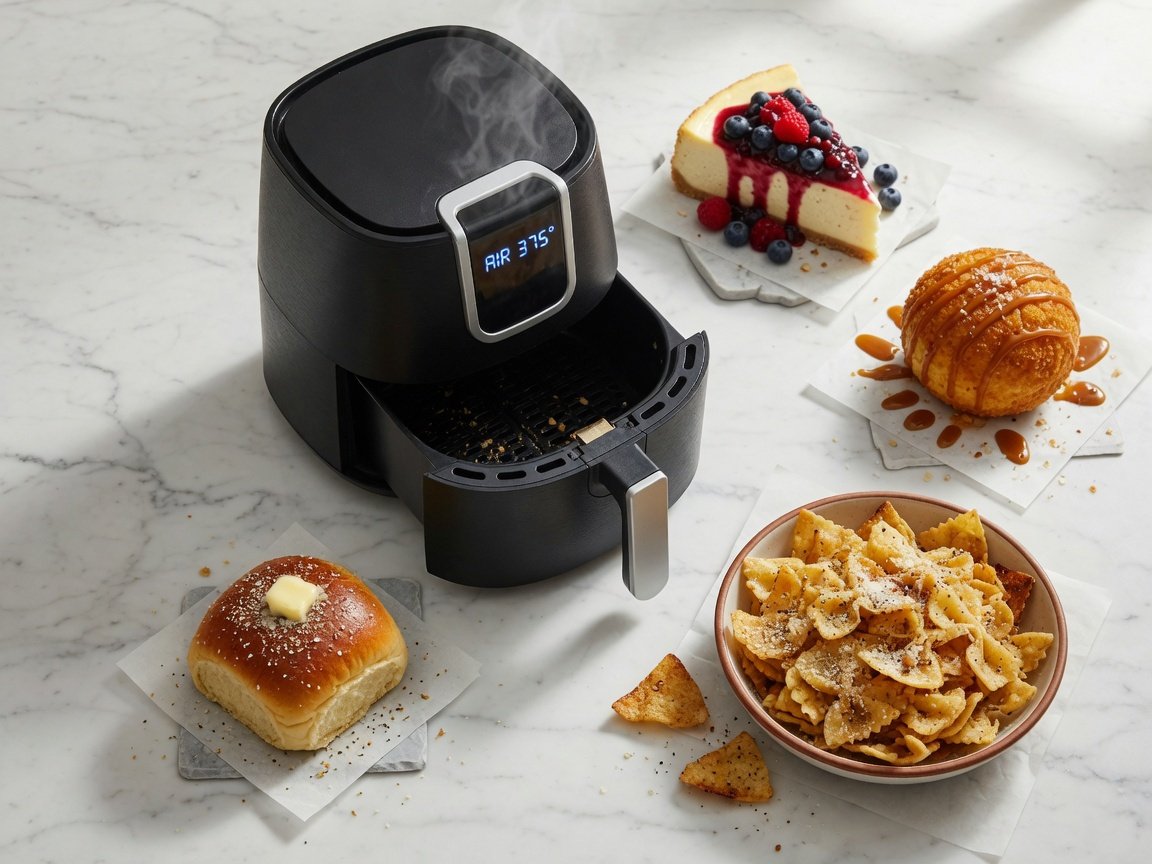
Can You Really Bake a Full Cheesecake in an Air Fryer?
Yes — and it might be the best cheesecake you’ve made at home. Cheesecake needs gentle, even, sustained heat. That’s precisely what the air fryer’s convection environment delivers, especially in a 6-inch springform pan that fits snugly inside a standard 5–6 qt basket. The machine doesn’t just handle this; it arguably handles it better than a conventional oven does.
The process is standard: cream cheese, sugar, eggs, vanilla — beat until smooth. Pour into a parchment-lined springform pan. Cover loosely with a foil tent and air fry at 300°F (150°C) for 15 minutes. Remove the foil, then continue for 10–15 more minutes until the centre is just set with a slight wobble. Cool to room temperature, then refrigerate for at least 4 hours before slicing.
The most frequently cited advantage isn’t the speed — it’s the absence of the water bath. Traditional oven cheesecake requires a bain-marie to regulate moisture and prevent cracking. The enclosed environment of the air fryer basket provides that moisture regulation naturally. Home bakers consistently report fewer cracks, cleaner edges, and a smoother surface compared to oven-baked versions. America’s Test Kitchen has noted that compact convection appliances often outperform conventional ovens on delicate custard-based recipes because heat regulation is more consistent at low temperature settings in a smaller space.
Other desserts that genuinely work: molten lava cakes (8 minutes at 375°F), churros (5–7 minutes at 375°F with a light oil spray), glazed donuts made from biscuit dough (6 minutes at 350°F), and cinnamon rolls from scratch that puff beautifully in 8 minutes at 350°F. None require special equipment beyond a standard basket-style air fryer.
Is Fried Ice Cream in an Air Fryer Actually a Real Thing?
It is — and the technique is clever once you understand the mechanism. Traditional fried ice cream relies on freezing a coated scoop so hard that a 3-second dip in hot oil crisps the exterior before the ice cream melts. The air fryer replicates this with a 400°F blast of circulated hot air that crisps the coating in 60–90 seconds flat. It’s faster, dramatically less messy, and produces a shatteringly crispy shell around ice cream that’s still cold and fully intact inside.
The technique requires a double-freeze cycle that most people skip on first attempt. Scoop firm ice cream balls and freeze on a lined tray for 2 hours. Dip each ball in beaten egg, then roll in crushed cornflakes mixed with 1 tablespoon of cinnamon sugar. Freeze the coated balls for a further 30 minutes minimum. Then air fry at 400°F for exactly 60–90 seconds. The coating crisps; the ice cream doesn’t have time to melt.
Pro tip: The second freeze is non-negotiable. A single-coat, single-freeze approach almost always fails — the ice cream softens before the coating has time to crisp. The 30-minute post-coat freeze is what buys you the window you need. Have plates and spoons ready before the basket opens and serve within 60 seconds.
Culinary educators who’ve tested this recipe extensively note that the single most important variable is starting ice cream hardness. Soft-serve or slightly thawed ice cream will always fail regardless of the coating. You need hard-frozen scoops — taken from the coldest part of your freezer — from the very beginning. Vanilla is the best starting point because its higher fat content holds structure under brief heat exposure better than fruit-based or lower-fat options.
Once you’ve nailed the base technique, the variations are limitless. Mango ice cream coated in toasted coconut flakes. Chocolate ice cream in a dark brownie crumb coating. Cookies-and-cream coated in Oreo crumble. The method is identical every time: freeze hard, double-coat, re-freeze, 90 seconds at 400°F, serve immediately.
Can You Cook a Whole Roast Chicken in Under 40 Minutes?
Absolutely — and the skin comes out better than most ovens can manage. A 4-pound chicken cooked breast-side down for 20 minutes at 380°F, then flipped and finished for 15–18 more minutes, reliably hits an internal temperature of 165°F with mahogany-golden skin that audibly crackles when you press it. Compare that to 90+ minutes in a conventional oven, and it’s the kind of time saving that permanently changes weeknight cooking habits.
Season as usual: herb butter pushed under the skin over the breast and thighs, olive oil rubbed on the outside, then salt, pepper, garlic powder, and smoked paprika all over. The single most important prep step is drying the skin completely — pat with paper towels until there’s no visible surface moisture. Any dampness on the skin creates steam during cooking, which is the enemy of crispness. Spatchcocking is optional but helps with both fit and even heat distribution in tighter baskets.
Basket size is the binding constraint. Standard 5-qt baskets comfortably handle birds up to about 4 pounds. Anything larger needs more room. If you’re planning to scale up to a holiday bird, checking the best air fryers for turkeys in 2026 before you buy will save a frustrating discovery on the day.
Whole salmon fillet — 400°F for 10–12 minutes. Skin crisps like a restaurant finish with no oil in the pan.
Duck breast — 400°F for 12 minutes. Fat renders faster than any stovetop method; skin crackles with no babysitting.
Rack of lamb — 400°F for 12–14 minutes. Even dark crust, pink centre, no grill required.
Stuffed pork tenderloin — 370°F for 22–25 minutes. Slice into rounds to serve. Looks cheffy, requires almost no effort.
Is Baking Bread in an Air Fryer Actually Worth Trying?
For small loaves, rolls, and quick breads — genuinely yes. For full sourdough boules or large sandwich loaves — capacity and steam requirements become limiting factors quickly. But for everyday small-batch baking, the results are fast enough, consistent enough, and energy-efficient enough that a growing number of home bakers have quietly abandoned their conventional ovens for weekday loaves.
A small white sandwich loaf in a 6-inch pan takes 25 minutes at 320°F. Dinner rolls finish in 12–14 minutes at 330°F with a golden crust and genuinely fluffy interior. Banana bread — arguably the most popular air fryer bake of 2026 — takes 23–25 minutes at 310°F and comes out without the dry edges that a conventional oven often produces at the sides of a loaf pan. Bagels (after their brief stovetop boil) take 10 minutes at 330°F and develop excellent crust.
The physics work in your favour here. The air fryer’s rapid convection causes dough to spring and set faster than in a conventional oven. Home bakers frequently report 10–15% more visible rise in the first few minutes compared to an oven at the same temperature, because the heat surrounds the dough immediately rather than building up gradually from a distant heating element. The enclosed space also retains the moisture the dough releases, which keeps crumb structure softer.
Basket depth matters for anything with real height. Taller loaves need vertical clearance that not every model provides. Several large-capacity models specifically designed for extended baking solve this well — the best large air fryers of 2026 cover a range of basket depths suited to serious home bakers who want to go beyond the basics.
What Are the Wildest Viral Air Fryer Trends of 2026?
Social media has turned the air fryer into a culinary playground, and 2026 has produced some trends that have genuinely crossed over from internet curiosity to useful kitchen technique. Here are the ones that actually deliver on the hype.
Pasta Chips
Boil rigatoni or farfalle to al dente, toss with olive oil, garlic powder, and smoked paprika, then air fry at 400°F for 10–12 minutes. The pasta puffs slightly and crisps into something that sits between a chip and a crouton — deeply savoury, impossible to stop eating. This trend has accumulated several hundred million views across platforms in 2026. Serve with marinara or whipped ricotta for dipping and it becomes the most-requested snack at any gathering where you make it.
Dehydrated Fruit
Many air fryer models sustain low temperatures of 130–150°F for extended periods. At those settings, thinly sliced strawberries, apples, and mango dehydrate in 2–3 hours — often faster than a dedicated dehydrator. Food scientists note that the convection airflow in air fryers removes surface moisture more evenly than passive dehydrators, which tend to over-dry the edges while leaving centre slices underdone. The result is consistent texture throughout each piece rather than the uneven batch you’d get from a basic dehydrator tray.
Home-Roasted Coffee Beans
Niche, but genuinely impressive. Green unroasted coffee beans air-roasted at 380°F for 8–12 minutes reach a light-to-medium roast. Results vary more than a drum roaster produces, but the freshness factor is hard to argue with — roasting and brewing happen within the same hour, and coffee enthusiasts who’ve tried it report a noticeably cleaner, more complex cup compared to even “fresh” pre-roasted beans that have been sitting on a shelf for days or weeks.
Avocado Fries
Slice a firm avocado into wedges. Coat in panko and seasoning. Air fry at 400°F for 7–8 minutes. The exterior becomes a shatteringly golden shell; the inside stays creamy and warm. Serve with a chipotle-lime dipping sauce. It sounds absurd until you try it — after which it sounds like something that should have existed years ago.
What Are the Most Surprising Savoury Dishes You Can Air Fry?
The savoury side of air fryer creativity runs deeper than most people expect. The table below covers dishes that work better in an air fryer than in their “native” cooking environment — results that surprise even experienced home cooks on first attempt.
| Dish | Temp | Time | Why It’s a Surprise |
|---|---|---|---|
| Eggs in-shell (no water) | 250°F | 15–17 min | No pot, no boiling — shell peels cleanly every time |
| Corn on the cob | 400°F | 12–14 min | Caramelises the kernels like a grill without uneven char |
| Stuffed bell peppers | 360°F | 15–18 min | Filling heats through while the pepper top chars beautifully |
| Grilled cheese sandwich | 370°F | 5–6 min | Even golden crust both sides — no flipping, no skillet anxiety |
| Steak (1-inch cut) | 400°F | 10–14 min | Consistent medium-rare with a well-developed crust |
| Breaded pickle chips | 400°F | 8–10 min | Tangy, shatteringly crispy — deep-fried taste without the oil |
| Mac and cheese bites | 375°F | 8 min | Crispy shell, molten interior — works from frozen in minutes |
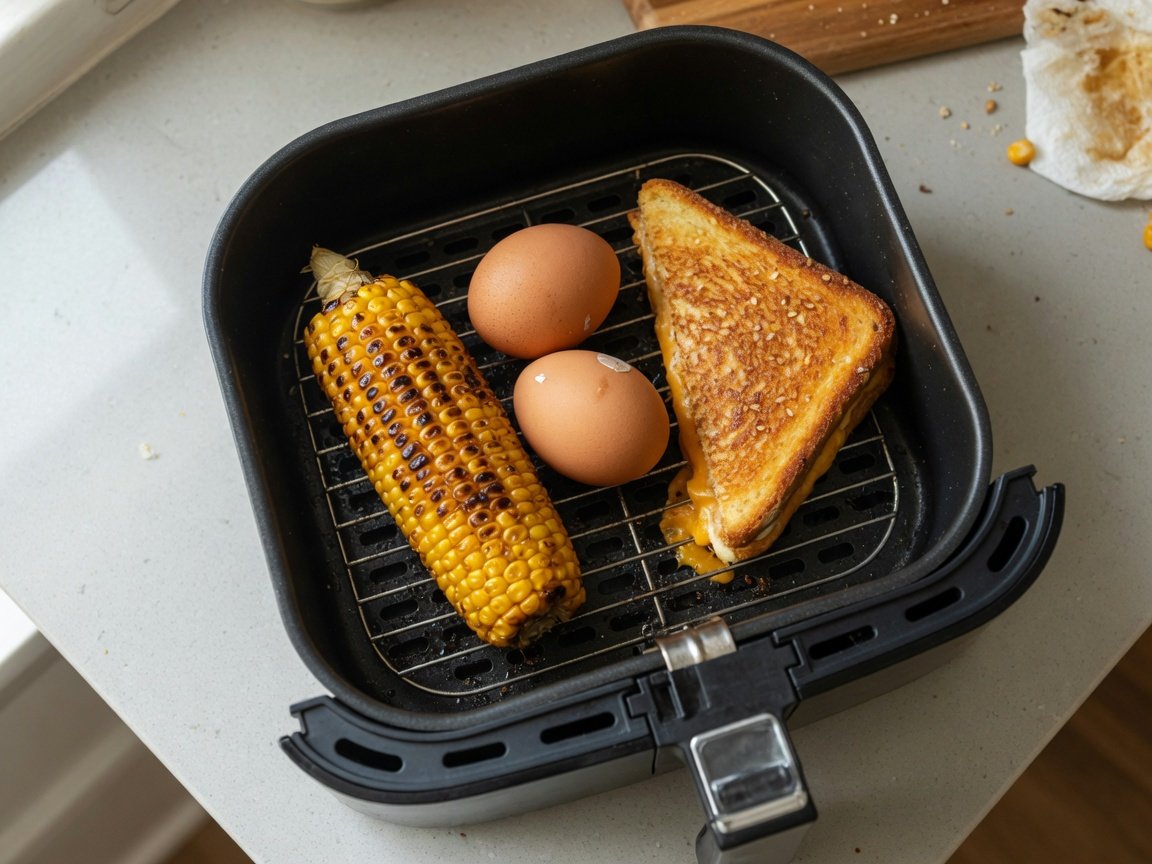
The in-shell egg technique deserves its own moment because it’s so counterintuitive. No water. No pot. No stove at all. Place whole, uncracked eggs directly on the basket grate at 250°F — 15 minutes for a firm yolk, 13 minutes for something slightly jammy at the centre. Transfer immediately to an ice bath for 5 minutes. Home cooks consistently report easier peeling compared to stovetop methods, likely because the gradual, even heat doesn’t bond the membrane to the white the way a rapid boil can.
The grilled cheese result is equally counterintuitive. Lay it flat in the basket, cook at 370°F for 3 minutes, flip, 3 more minutes. Both sides come out an even golden-brown. The cheese melts completely. There’s no butter splatter, no pan to scrub, and no risk of one side burning while you’re distracted. Food technologists studying home appliance cooking note that the radiant-plus-convection heat combination in basket-style air fryers produces more even Maillard browning on flat surfaces than a skillet does, because the heat source isn’t localised at one point of contact.
A home cooking blogger documented a 30-day experiment in 2026 cooking one unconventional air fryer recipe daily, tracking cook times, energy consumption via a smart plug monitor, and ingredient costs versus traditional cooking methods. Results across the 30 days: an average cook time reduction of 31% compared to oven or stovetop equivalents; an estimated monthly energy saving of $11–14 on electricity based on wattage difference versus oven usage for the same recipes; and a recipe success rate of 26 out of 30 — the four failures included a wet-batter attempt without a parchment liner, an oversized loaf that hit the heating element, and two overcrowded baskets that steamed rather than crisped. Notable successes included full cheesecake, fried ice cream, in-shell eggs, pasta chips, dehydrated strawberries, and a whole roast chicken that was on the table 38 minutes after the bird went in.
Step-by-Step: How to Pull Off the Five Craziest Air Fryer Recipes
Here’s exactly how to execute the five most impressive recipes on this list — with the specific details that separate a great result from a disappointing one on first attempt.
1. Air Fryer Cheesecake
- Beat 16 oz room-temperature cream cheese with ½ cup sugar, 2 eggs, and 1 tsp vanilla until completely smooth — no lumps.
- Pour into a 6-inch springform pan lined with parchment. Tap the pan twice on the counter to release air bubbles.
- Cover loosely with a foil tent. Air fry at 300°F for 15 minutes.
- Remove the foil. Continue air frying for 10–15 more minutes until the centre is just set with a very slight wobble.
- Cool to room temperature for about 1 hour, then refrigerate for at least 4 hours before slicing.
2. Fried Ice Cream
- Scoop 4 firm balls of ice cream onto a lined tray. Freeze for a minimum of 2 hours.
- Dip each ball in beaten egg, then roll in crushed cornflakes mixed with 1 tbsp cinnamon sugar until fully coated.
- Return to the freezer for at least 30 minutes. This step is not optional — skip it and the ice cream melts before the coating crisps.
- Air fry at 400°F for exactly 60–90 seconds. No longer.
- Serve immediately with caramel sauce. Have everything plated before the basket opens.
3. Pasta Chips
- Boil 2 cups of rigatoni or farfalle to al dente. Drain and pat dry thoroughly with a clean kitchen towel.
- Toss with 2 tbsp olive oil, 1 tsp garlic powder, ½ tsp smoked paprika, and ½ tsp salt.
- Spread in a single layer in the basket. Do not stack — cook in two batches if needed.
- Air fry at 400°F for 10–12 minutes, shaking firmly at the 6-minute mark.
- Season with grated Parmesan immediately after cooking. Serve with marinara or whipped ricotta.
4. In-Shell Eggs (No Water, No Pot)
- Place whole, uncracked eggs directly on the air fryer basket grate. No preparation required.
- Air fry at 250°F — 13 minutes for a slightly jammy yolk, 15–17 minutes for fully firm.
- Transfer immediately to an ice bath for 5 minutes.
- Peel under cold running water. Shell releases cleanly with minimal effort.
5. Whole Roast Chicken
- Pat a 3.5–4 lb chicken completely dry. Push softened herb butter under the skin over the breast and thighs.
- Rub the outside with olive oil, paprika, garlic powder, salt, and black pepper all over.
- Place breast-side DOWN in the basket. Air fry at 380°F for 20 minutes.
- Flip to breast-side UP. Continue at 380°F for 15–18 minutes until an instant-read thermometer reads 165°F at the thickest part of the thigh.
- Rest for 5 minutes before carving. The skin should shatter, not flex, when you press it.
What Are the Real Limits of Air Fryer Cooking?
For all its versatility, the air fryer has genuine limits. Knowing them before you experiment saves wasted ingredients, frustrating results, and — in at least one specific case — a kitchen that smells like scorched batter for two days.
Failure modes to know before you start: Very wet or runny batters — beer batter, loose tempura — drip through the basket grate and burn on the heating element before the coating has time to set. Very lightweight dry items like loose fresh herbs or fine breadcrumbs get blown around by the fan. Anything requiring sustained liquid immersion or long, slow braising in sauce doesn’t belong in a basket-style air fryer at all.
Wet batters are the single most common first-attempt disaster, and the fix is straightforward. Use a dry coating — panko, crushed cornflakes, or breadcrumbs — or place a parchment liner in the basket to catch drips before they reach the element. Air fryer-specific perforated parchment liners are widely available and solve the problem completely for any recipe that involves a wet or sticky coating.
Overcrowding is the second most common issue, and it’s frequently misdiagnosed. When the basket is too full, food steams rather than crisps — people blame the machine, but it’s almost always a capacity problem. The rule is a single layer with items spaced slightly apart, cooking in batches rather than piling it in. For anyone cooking regularly for more than two or three people, a dual-basket model is the practical solution — the best dual-basket air fryers of 2026 let you run two different recipes at two different temperatures at the same time.
If something didn’t come out the way it should, the problem is almost always one of five things: overcrowding, a too-wet coating, insufficient preheat time, incorrect temperature, or smoke from dripping fat. The complete air fryer troubleshooting guide walks through all five in detail, with specific fixes for each scenario — it’s worth reading before you decide the machine is at fault.
What’s Coming for Air Fryers Between Now and 2027?
The air fryer category is moving faster than most kitchen appliance categories. Three converging trends are shaping what the appliance looks and performs like heading into 2027.
AI-assisted real-time cooking adjustment. Several 2026 models include wireless connectivity and app-based libraries that auto-set temperature and time based on food weight and type. By 2027, real-time mid-cycle adjustment — where the appliance modifies its cooking cycle based on internal sensor readings — is expected to become a standard feature at the mid-range price point rather than a premium differentiator. Culinary technology researchers tracking the appliance category describe this as the most significant feature evolution since the introduction of preset programs.
Steam-plus-air hybrid cycles. Several manufacturers are integrating steam injection into air fryer designs for 2026 and 2027 models. This unlocks applications that traditional air fryers handle poorly — proofing bread, steaming dim sum, cooking egg custards — while retaining the rapid-air crisping function for finishing. Food technologists predict the hybrid form factor will account for a significant and growing share of premium air fryer sales through late 2027 and into 2028.
Larger capacity in the same counter footprint. Manufacturers are engineering 10-qt and 12-qt baskets into roughly the same physical dimensions as current mid-range units, with mainstream retail pricing expected by late 2027. If you’re considering upgrading before then, looking at what currently tops the rankings among the best-performing air fryers of 2026 gives a solid baseline for where the technology standard is heading.
Frequently Asked Questions About Crazy Air Fryer Cooking
What is the single most surprising thing you can cook in an air fryer?
A full cheesecake gets the most consistent “wait, really?” reaction. A smooth, crack-free 6-inch cheesecake with a properly set filling — no water bath, no fuss — in about 30 minutes. It works reliably every time once you’ve dialled in the temperature and used the foil-tent trick for the first half of the cook.
Can you actually bake bread in an air fryer?
Yes, within limits. Small loaves, dinner rolls, banana bread, cinnamon rolls, and bagels all work well. Full sourdough boules or large tin loaves are harder because of basket height restrictions and the steam requirements of the initial bake phase. For everyday small-batch baking, an air fryer is genuinely faster and significantly more energy-efficient than a full oven.
Will fried ice cream actually stay frozen in the air fryer?
Yes — if you follow the double-freeze method exactly. Freeze the coated balls for 30+ minutes before cooking and keep the cook time to 60–90 seconds at 400°F. Any longer and the ice cream starts to melt through the coating. Serve within a minute of it leaving the basket. This is not a make-ahead dish.
What foods should you never put in an air fryer?
Very wet batters without a liner will drip and burn on the heating element. Large quantities of lightweight dry ingredients can blow around and contact the element. Anything requiring liquid immersion or long slow braising — soups, stews, braised meats in sauce — doesn’t work in a basket-style air fryer. Use a pot or a covered oven dish for those.
How do you stop an air fryer from smoking when cooking fatty meats?
Add a tablespoon of water to the drawer below the basket before you start cooking. The water absorbs fat drips before they hit the hot element and combust into smoke. A slice of bread in the drawer works the same way — it soaks up grease as it falls. Both fixes work consistently for bacon, duck, pork belly, and any other high-fat protein.
Do you need a special air fryer to try these wild recipes?
Most recipes on this list work in any standard 5–6 qt basket air fryer. The exceptions are whole chicken (needs a 6–7 qt minimum for a 4-lb bird), tall bread loaves (need vertical clearance), and cheesecake (needs a 6-inch springform pan that fits without touching the element). For those, a larger-capacity model gives you the space you need without compromises.
Can you dehydrate food in a standard air fryer?
Yes, if your model has a low-temperature setting around 130–150°F. Many 2025 and 2026 models include a dedicated dehydrate function precisely for this purpose. Thinly sliced fruit, herbs, and jerky all dehydrate well at these settings in 2–4 hours. Results are often more even than a standalone dehydrator, because the convection airflow is stronger and more consistent across the whole tray.
What Should You Try First?
If you’ve been using your air fryer only for the obvious things, here’s a sensible progression from surprising to genuinely wild — ordered by complexity and the risk of wasted ingredients.
- This week — in-shell eggs at 250°F: 15 minutes, zero risk, costs nothing if it goes wrong. It’s the fastest way to prove the machine does more than you thought.
- Next weekend — pasta chips: Boil, season, 12 minutes at 400°F. They’re impossible to stop eating and permanently change how you see pasta.
- When you want to impress — air fryer cheesecake: Looks professional, takes 30 minutes of cook time, requires no water bath. Use the foil-tent trick. Chill overnight for best results.
- For a genuine party trick — fried ice cream: Double-coat, double-freeze, 90 seconds at 400°F. Serve within a minute. Watch the room.
- The ultimate test — whole roast chicken: If your basket fits a 4-lb bird, this one changes weeknight cooking for good. Better skin, faster cook time, less oven heat in the kitchen, and fewer things to wash up.
The craziest thing about air fryer cooking in 2026 isn’t any single recipe — it’s the pattern. Every time someone assumes the machine can’t handle something, they try it anyway, and it usually works. The limits exist, but they’re narrower than most people expect. Start with one recipe from the list above. The second one will feel obvious. The third will feel like the machine was built for it all along.
— **Schema Markup** *(already embedded above — shown separately for reference)* See the `