
All right, if you’re eyeing Chefman or KitchenAid programmable multi-cookers with air fryer functions, we’re basically talking about two different ways to elevate dinner with confidence. Chefman leans big-batch, preset-heavy, and a little no-nonsense, delivering consistent results and streamlined meal prep. KitchenAid goes more oven-style, with smart controls and app niceties that I, frankly, pretend I’ll use more than I do, but they still deliver precise temperature management and versatile cooking modes.
Obviously, both can crisp, roast, bake, and dehydrate, but the real question is which one fits your kitchen—and which one’s about to win your countertop. If you’re prioritizing speedy, hands-off cooking for family meals, Chefman offers straightforward presets and rapid preheats to save time. If you want elevated control, smart connectivity, and a premium user experience, KitchenAid provides app-enabled monitoring, precise temps, and robust versatility to cover a broader range of recipes. Choose Chefman for reliability and volume cooking, or KitchenAid for advanced features and refined, oven-like performance.
Chefman vs. KitchenAid Air Fryer Multi-Cookers
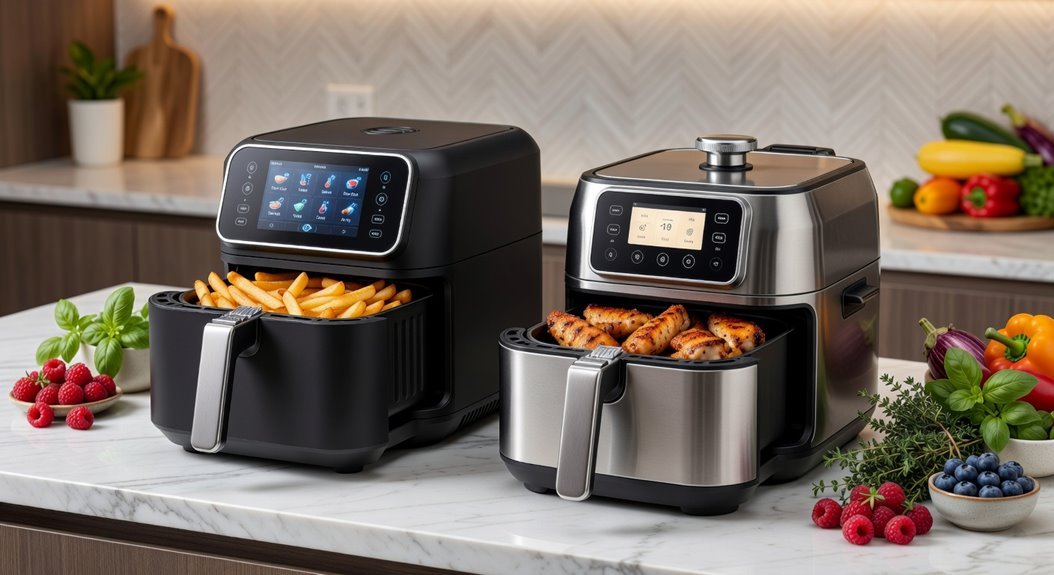
When you’re comparing Chefman and KitchenAid air fryer multi-cookers, you’re basically choosing between brute-force family-feeding convenience and a more polished, oven-style setup.
We’d say Chefman wins if you want big 10–14 quart batch cooking, 1700W punch, 17 presets, and no preheat drama, it’s the sensible choice when dinner’s already late and everyone’s hungry.
KitchenAid feels pricier, but its convection-style racks, app control, and premium finish suit you if you like a countertop appliance that behaves like a compact oven.
Obviously, comparison pricing matters, but so does warranty coverage: Chefman’s usually 1 year, while KitchenAid leans on stronger service options.
I’m biased toward the simpler, meat-and-potatoes approach; you may prefer the fancier one.
Either way, your fries won’t care.
How Air Frying Works in Multi-Cookers
So, how does air frying actually work inside a multi-cooker? We’re basically blasting food with rapid hot air from a built-in convection fan, and you get that fried-like crunch with little to no added oil, which is great for oil reduction. You’ve probably noticed the dedicated Air Fry or Hi-Fry setting on some models; it cranks heat and fan speed, often up to 400–450°F, so you can chase crisp edges without babysitting. I mean, the chamber, racks, and airflow dynamics are all designed to expose every side of your food, like a very energetic fan club.
All right, some units even skip preheat or keep it brief, so you can get cooking fast. Perforated baskets and wire racks help, too.
Chefman Models to Compare
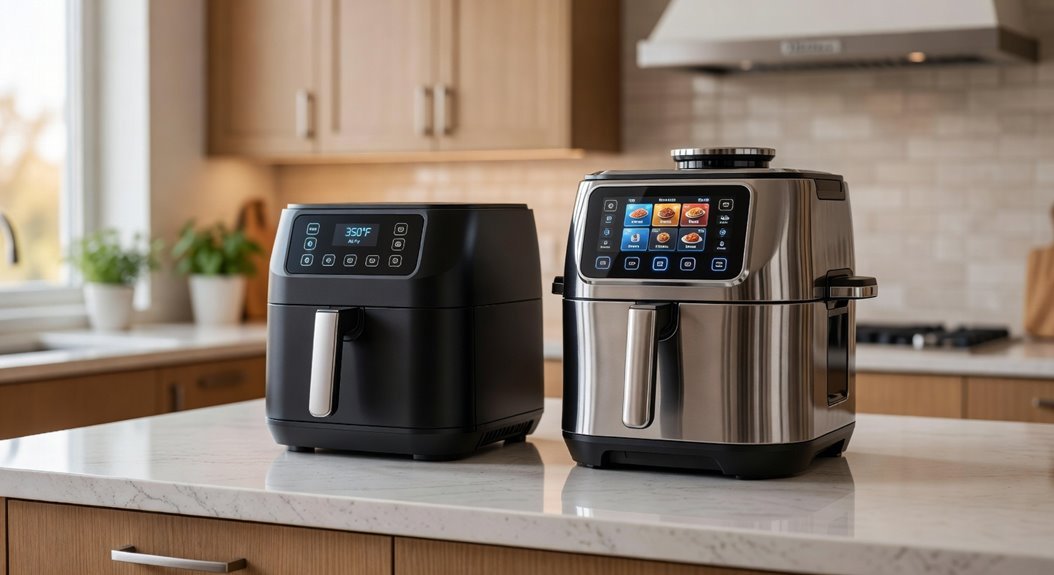
All right, when you’re comparing Chefman models, we’d start with capacity first, because a 10-quart unit like the RJ38-10-RDO-V2 feels a lot different from a 14-quart version when you’re feeding a crowd, and I’m sure you’ve noticed that the difference is basically “weeknight dinner” versus “who invited the whole neighborhood?”
Then we’d line up the features you actually care about, since some Chefman models keep it simple with air fry, bake, roast, dehydrate, and reheat, while others throw in a rotisserie spit, interior light, Hi-Fry 450°F, and extra rack positions like they’re trying to win a kitchen arms race.
Obviously, if you’re like us and prefer fewer dishes and less chaos, the dishwasher-safe parts, digital touch controls, and built-in safety/warranty basics make the comparison pretty easy.
Chefman Capacity Options
Chefman’s capacity lineup is where things get interesting, because you’re not just picking a basket size, you’re deciding how much dinner, leftovers, and general kitchen chaos you want to handle in one shot. We’re talking capacity options from 10 quarts up to 14, so you’ve got room for weeknight wings or a frankly suspicious amount of fries. I’m sure you’ve noticed the 10-quart RJ38-10-RDO-V2 brings 17 presets and 1700W, which helps meals move fast without making you babysit.
Now, the large unit features in the 14-quart models are the real party trick: three rack positions and a rotisserie spit with a retrieval tool. Obviously, some units skip preheating and handle dehydrating, roasting, and baking too. Cleanup’s easy, too, because the drip tray and dishwasher-safe racks don’t argue back.
Chefman Feature Comparison
What’re you actually comparing here, you ask? We’d look at the Chefman RJ38-10-RDO-V2 first, since it’s the 10-quart, 1700W model with 17 presets, and that’s where the real kitchen muscle shows up.
You get air fry, bake, roast, rotisserie, and dehydrate, plus a viewing window, interior light, and three airflow racks, so you can watch dinner like it’s a tiny reality show.
Obviously, it’s built for weeknight speed, with no preheat and dishwasher-safe cleanup.
We like the oil-cut claim, too—up to 98% less than deep frying, which is less a marketing strategy than a small miracle.
If you’re comparing features, not some unrelated topic, this one’s about family-size flexibility, not fancy fluff.
We’re biased toward practical wins, and this one earns its spot.
KitchenAid Models and Smart Controls
Now, when you’re looking at KitchenAid models with air fry, the big thing to notice is that they usually aren’t doing magic so much as using built-in convection fans to blast hot air around the food, which is how you get that crispy finish without drowning everything in oil. We’re talking smart controls, model availability, and whether your unit gives you a button, an app, or both.
| Option | Access | Note |
|---|---|---|
| Dedicated control | On appliance | Fastest for you |
| Mobile app | Connected models | Handy if you’re stubborn like us |
| OTA updates | Selected units | Can expand presets |
Obviously, you’ll want the manual, because rack position and tray placement matter more than our barbecue opinions. Air fry baskets or perforated trays help airflow, and, yes, that’s a fancy way of saying “don’t crowd the food.”
Other Modes to Compare
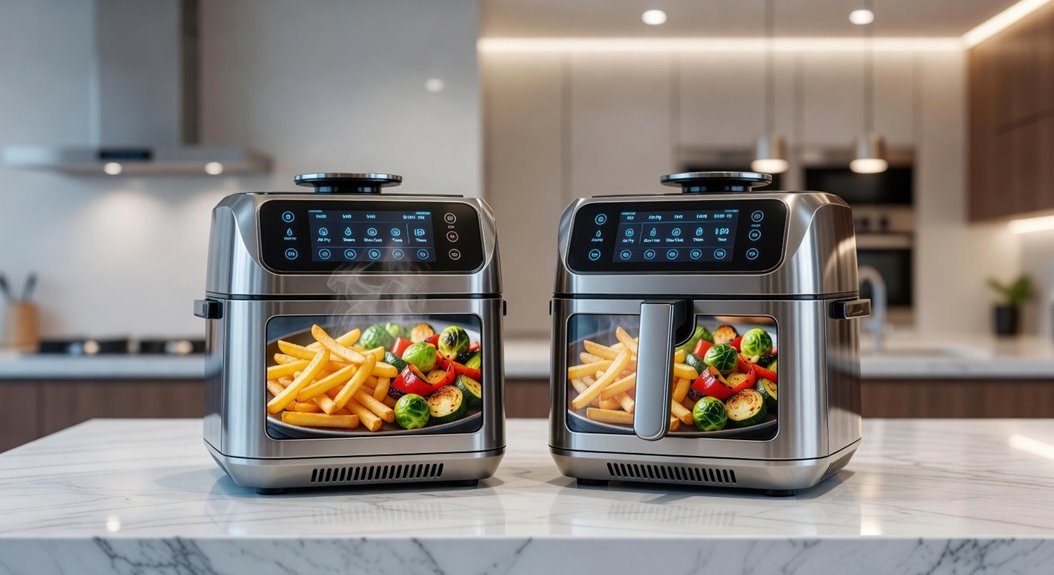
All right, when you’re comparing these Chefman and KitchenAid cookers, we’ve gotta look past air fry and see what else you actually get, because bake, roast, dehydrate, and those extra multi-cook modes can turn the thing into a tiny kitchen on your counter. You’ve probably noticed some models also add rotisserie, broil, and reheat, which is handy if you want crispy chicken one night and leftovers that don’t taste like punishment the next day.
Obviously, more presets don’t automatically mean better—somewhere between 5 and 17, I’m sure the exact number depends on the model and my ability to count after dinner—but they do give you more ways to use the machine without making you babysit it like a nervous campfire.
When you’re evaluating top-rated Chefman and KitchenAid countertop ovens, prioritize models offering bake, roast, dehydrate, and multi-cook presets to maximize versatility on your counter. Look for additional functions like rotisserie, broil, and reheat to deliver restaurant-quality results for fried chicken nights and leftover repurposing without bland reheats. More presets provide expanded capabilities and streamlined operation, reducing user oversight while preserving flavor, convenience, and speed.
Air Fryer Modes
So, when you’re looking at air fryer modes in these programmable multi-cookers, you’re really looking at the part of the machine that tries to fake a full-size countertop air fryer without taking over your kitchen like an overly confident houseguest.
You’ll usually get dedicated air fry with convection heat and temps up to about 400–450°F, and I’m sure you’ve noticed the best units throw in a Hi-Fry or final crisp boost at the end.
All right, the presets, often 8 to 12, help you nail chicken, fries, vegetables, and pastries without guessing like a raccoon in a pantry.
You can peek through the window and light, and the dishwasher-safe racks and trays keep cleanup easy.
Battery life, obviously, none.
Color options, nice, but they won’t make fries crispier.
So, when you’re looking at air fryer modes in these programmable multi-cookers, you’re really looking at the part of the machine that tries to fake a full-size countertop air fryer without taking over your kitchen like an overly confident houseguest.
You’ll usually get dedicated air fry with convection heat and temps up to about 400–450°F, and I’m sure you’ve noticed the best units throw in a Hi-Fry or final crisp boost at the end.
All right, the presets, often 8 to 12, help you nail chicken, fries, vegetables, and pastries without guessing like a raccoon in a pantry.
You can peek through the window and light, and the dishwasher-safe racks and trays keep cleanup easy.
Battery life, obviously, none.
Color options, nice, but they won’t make fries crispier.
Multi-Cook Functions
Beyond air frying, these Chefman and KitchenAid multi-cookers start looking like the kitchen equivalent of a Swiss Army knife that actually earned its keep. You get bake, roast, broil, and dehydrate, and some even toss in rotisserie gear, which is handy if you’re the sort of person who thinks dinner should multitask too. I’m sure you’ve noticed the presets do a lot of the heavy lifting.
| Mode | Best use | Notes |
|---|---|---|
| Bake | quick desserts | steady heat |
| Roast | chicken, veg | browning |
| Broil | top finish | fast |
| Dehydrate | snacks | low temp |
| Rotisserie | whole bird | accessory |
All right, the 90–450°F range and 1500–1700W power help, while viewing windows, lights, and touch controls keep you sane. For budget options, compare preset counts and warranty coverage before you buy.
Capacity, Racks, and Cleaning
When it comes to capacity, racks, and cleanup, these Chefman multicookers are built like they expect you to actually feed people, not just stare at countertop appliances and admire the finish. We’re talking 10–14 quarts, so your capacity comparisons start looking less like a snack machine and more like a small holiday strategy. You get multiple racks, often three wire racks, plus a rotisserie spit and retrieval tool, which is a fancy way of saying you can stack dinner like a very organized Jenga tower. I’m sure you’ve noticed the viewing window and interior light save you from opening the door every five minutes like a nervous raccoon. Obviously, the removable, top-rack dishwasher-safe parts make cleaning considerations easier, and the drip tray helps too. Cleanup’s not glamorous, but neither is scrubbing a pan at midnight.
Which Model Should You Buy?
All right, if you’ve already figured out that capacity and cleanup are doing a lot of the heavy lifting here, the real question is which Chefman model actually fits your kitchen life without making you feel like you bought a small aircraft instead of an air fryer. We’d steer you toward the 10-quart RJ38-10-RDO-V2, the sweet spot for solid family-size cooking, 1700W power, 17 presets, and a wide temperature range. If you’re feeding a crowd, the 14-quart model wins the capacity comparison, and those rack configurations plus the rotisserie spit are the flashy extras.
Want smarter guided cooking, the 12-quart with its thermometer and 28 presets is the nerdy overachiever. Obviously, if you don’t need the extras, keep it simple.
Frequently Asked Questions
Are Chefman Air Fryers Good Quality?
Yes, we think Chefman air fryers are generally good quality, with strong performance and useful features. We’d discuss durability and compare pricing, since they’re often affordable, though long-term reliability can vary by model.
Yes, Chefman air fryers offer solid durability and dependable performance with practical features that appeal to home cooks. We compare pricing and value, noting they’re often budget-friendly, while long-term reliability can vary by model and usage.
Which Brand Is Better, Chefman or Ninja?
We’d usually pick Ninja in a Chefman vs Ninja comparison, like choosing a swift fox over a sturdy cart, it’s better for most kitchens. Chefman’s bigger, richer on accessories, but Ninja’s air-frying performance wins.
We’d usually pick Ninja in a Chefman vs Ninja comparison, like choosing a swift fox over a sturdy cart, it’s better for most kitchens. Chefman’s bigger, richer on accessories, but Ninja’s air-frying performance wins.
What Are Common Chefman Air Fryer Problems?
Common Chefman air fryer problems include power failures, tripped circuits, error codes, overheating, uneven cooking, and weak crisping; we can also see worn baskets or poor preheating causing issues. Usersubtopic ideas: air fryer issues.
What Is the 20 20 Rule for Air Fryers?
The 20 20 rule for air fryers means we cook for 20 minutes, check doneness, and shake or flip halfway around 10–12 minutes. We’ll avoid overcooking, keep food juicy, and get crisp results.
