
All right, if you’re eyeing the KitchenAid Professional 6-Quart, we’re talking bowl-lift stability, a 575-watt motor, and enough room for serious dough or a batch that makes your countertop look like it’s doing meal prep for a small hockey team. Compared with the Classic and Artisan, you get more muscle and capacity, and unlike the Pro Line, it stays a bit more practical.
The real question is whether that tradeoff fits how you actually cook, and that’s where it gets interesting.
What the KitchenAid Professional 6-Quart Does Best
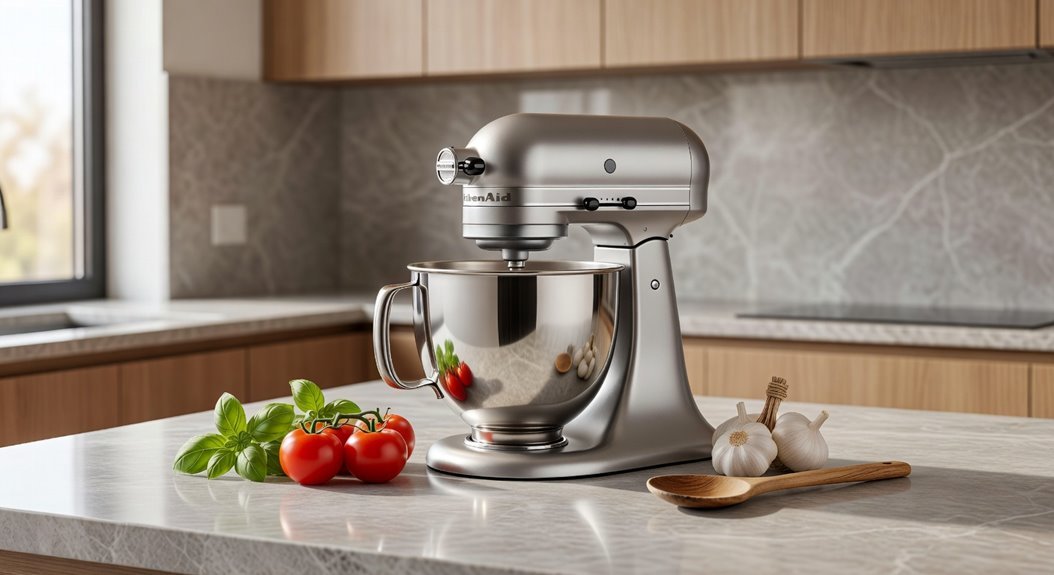
What does the KitchenAid Professional 6-Quart do best? We’d say it shines when you’re tackling heavy doughs and big batches, and you don’t want your mixer wobbling like a folding chair at a cookout. The bowl-lift design gives you bowl lift ergonomics that feel steadier, especially when you’re feeding in bread dough, cookie batter, or a double recipe of something ambitious.
Obviously, the larger 6-quart bowl helps, but the real win is how it handles repeated use with better motor heat management, so you’re less likely to baby it between loads. We’re biased toward serious baking, sure, but if you’ve ever wished your mixer acted more like a workhorse than a show pony, this is the lane it lives in.
Key Features of the KitchenAid Professional 6-Quart
All right, you’ll notice the KitchenAid Professional 6-Quart leans on a bowl-lift design, so when you’re working with heavy dough or a big batch, it stays steadier than a wobbly folding table at a barbecue.
We’re talking 6 quarts of capacity here—right in that sweet spot between the smaller everyday mixers and the bigger beasts, and, obviously, that extra room matters when you’re baking bread like you mean it.
It’s built with more power for frequent, demanding use too, and I’m biased, but that’s exactly the kind of reliability you want when your mixer’s working harder than the person slicing the cake.
Bowl-Lift Stability
Why does the KitchenAid Professional 6-Quart feel so planted? Because the bowl-lift design gives you dough stability when you’re mixing heavy batches, and the bowl lift impact is obvious the first time you run a dense dough. We’ve all seen mixers shimmy like they’re auditioning for a dance show, this one doesn’t.
- The bowl stays secure with substantial ingredients
- You can remove the bowl more easily after mixing
- Attachment changes feel straightforward, not fussy
I mean, the stainless steel bowl and sturdy build make it feel like a workhorse, not a toy. Obviously, you’re not buying it for tiny tasks alone. We like how the setup supports big baking days, and if you’re like us, that calm, no-drama feel is worth a lot, almost as much as not having flour everywhere.
Power And Capacity
Now that we’ve talked about how planted the bowl-lift setup feels, the KitchenAid Professional 6-Quart’s power and capacity are where you really see it earn the “professional” part of the name. You’re getting a 6-quart bowl, and that’s plenty for cookie dough, bread, or a double batch when you suddenly decide you’re hosting like you’ve got a catering permit. The motor’s around 575 watts in this line, and while I’m not pulling out a stopwatch, that’s enough grunt for dense doughs and long mixing sessions. In a power comparison, it’s built to keep up without complaining. That capacity emphasis matters. You get the usual dough hook, flat beater, and wire whip, so you’re set. Obviously, bigger batches mean fewer excuses.
Who the KitchenAid Professional 6-Quart Fits Best
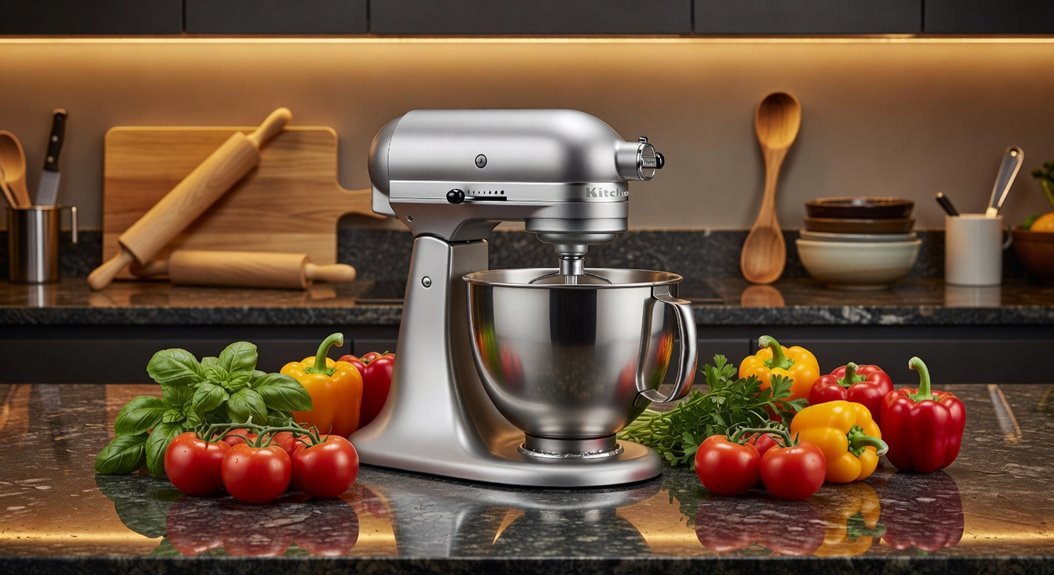
What’s the KitchenAid Professional 6-Quart really for? We’d say it fits you if you bake like it’s a habit, not a hobby. That bowl lift durability matters when you’re working heavy doughs, and the 6-quart bowl gives you room for serious batches without playing Tetris with batter.
- Frequent bread making
- Big cookie runs
- Small-to-midsize commercial kitchens
All right, if you want sustained power, those wattage differences over Classic and Artisan lines help keep dense mixtures moving without sounding like the motor’s negotiating its retirement. I mean, we’re biased toward tools that don’t complain. You also get the same family of attachments, so you can knead, whip, and mix with one machine. Obviously, it’s not tiny. It’s the mixer equivalent of wearing boots to a picnic, overprepared, maybe, but usually right.
KitchenAid Professional 6-Quart vs Classic and Artisan
If you’re already eyeing the KitchenAid Professional 6-Quart for heavy doughs and bigger batches, the comparison with the Classic and Artisan pretty much writes itself: this one’s the tank. You get bowl lift advantages, which means your mixing stays steadier when you’re pushing thick bread dough or big cookie loads, and that 6-quart bowl simply gives you more breathing room.
The Classic’s 4.5 quarts and the Artisan’s 5 are fine for everyday use, obviously, but if you bake often, the Professional feels like an overclocked motor wrapped in a sturdier shell. I mean, it’s less “cute countertop companion” and more “let’s do the work.”
We like the Classic and Artisan for versatility and looks, but you’ll probably like this one for power, capacity, and fewer excuses.
KitchenAid Professional 6-Quart vs Pro Line
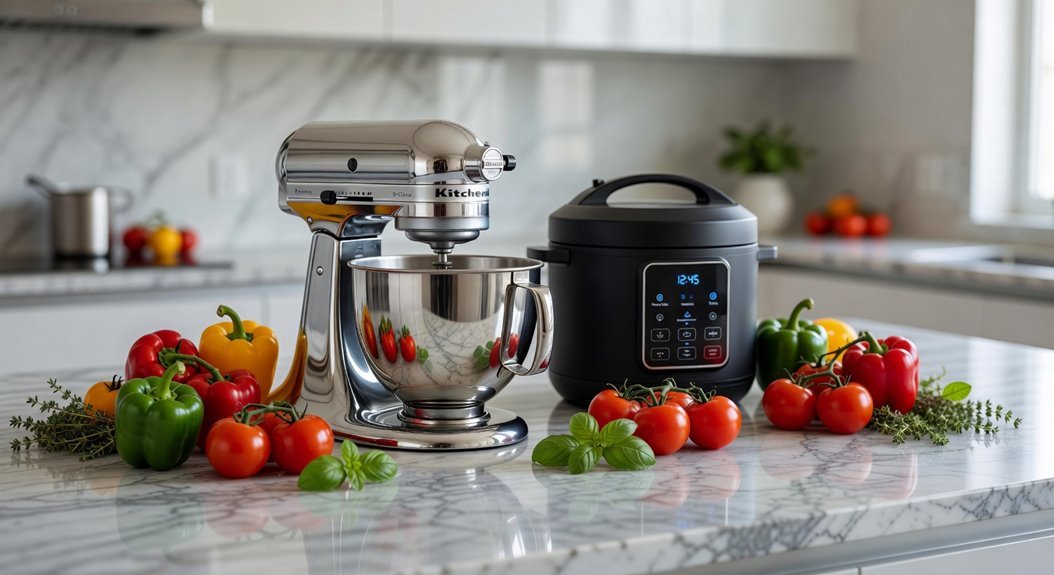
All right, you’ll notice both the KitchenAid Professional 6-Quart and Pro Line stick with a bowl-lift design, so they’re built to stay steady when you’re kneading heavy dough, instead of doing the kitchen equivalent of a dance move.
The Pro Line usually brings more capacity and power, often a 7-quart bowl and a beefier motor, while the Professional 6-Quart keeps things a bit more home-baker practical, which is my nice way of saying it’s plenty of machine unless you’re feeding a small army.
And if you want the fancier finishes, glass bowl options, or extra premium touches, the Pro Line’s the one that starts looking like the tuxedo at the barbecue.
Bowl-Lift Design
The bowl stays put, the pour-spout shield helps keep cleanup sane, you can lift out big batches without wrestling the machine. Obviously, it’s the less fussy cousin who still shows up ready to haul.
The bowl stays put, the pour-spout shield helps keep cleanup sane, you can lift out big batches without wrestling the machine. Obviously, it’s the less fussy cousin who still shows up ready to haul.
Capacity And Power
Now, when you look at the KitchenAid Professional 6-Quart, you’re basically looking at the sweet spot between “I bake enough to matter” and “I don’t need a machine that eats half my counter.”
The 6-quart bowl-lift setup gives you real room for bigger batches, so you can handle bread dough, double-cookie situations, and the kind of heavy mixtures that make smaller mixers sound like they’re negotiating a labor dispute.
We’re talking serious capacity power here—more muscle than Classic or Artisan models, with a bowl lift that keeps big loads steadier.
Obviously, it’s not the monster 7-quart Pro Line, but for us, that balance feels smart: enough strength for frequent large jobs, plus a footprint that still behaves in a home kitchen.
Pro Line Upgrades
If the 6-quart Professional feels like the smart middle ground, the Pro Line is where KitchenAid starts acting like it’s auditioning for a bakery backroom. You get more torque, a 7-quart bowl, and better stability, so you can mix bigger doughs without the machine wobbling like my elbows after too much barbecue.
All right, here’s the upgrade story:
- bowl lift aesthetics that look more serious, and honestly, you’ll feel it
- glass or polished stainless bowls for easier viewing and cleanup
- longer warranty coverage, because premium gear should last
I mean, if you’re chasing commercial-style output at home, the Pro Line makes sense. You’ll also get broader attachment compatibility, which is handy when you’re feeling ambitious. Obviously, it’s pricier, but you know what you’re paying for.
Why the Bowl-Lift Design Matters
Why the bowl-lift design matters, because if you’re mixing big doughs, we get steadier action and less wobble, which feels like bowl lift ergonomics done right.
| Feature | Why it helps |
|---|---|
| Raised bowl | Easier scraping |
| Lever action | Simple height changes |
| Heavy batches | Better stability |
| Shield, spout | Less splatter |
| Safety controls | Softer starts |
All right, you’ll notice the bowl moves up and down, so adding flour or cleaning the sides doesn’t turn into a gym workout. Obviously, larger 5–7 quart bowls fit the job better, and the stronger motors usually keep pace. We’re also fans of the soft start and auto-off bits, since motor heat factors aren’t exactly charming. Honestly, it’s the mixer equivalent of wearing work boots instead of flip-flops.
Which Attachments Are Worth Using?
Honestly, the attachments are where you stop just owning the KitchenAid Professional 6-Quart and start actually using it like the beefy kitchen workhorse it is. You’ve got the dough hook, flat beater, whisk, and pouring shield, and, frankly, those cover most of what you’ll do.
- Use the dough hook for heavy breads; it’s the reason you bought this beast.
- Use the flat beater for cookies and batters, where accessory durability matters.
- Use the whisk when you want fluff, not elbow grease.
I mean, the bowl-lift setup and 6-quart size make these tools feel less like gimmicks and more like proper gear. Obviously, you can chase add-ons, but we’d start here. The motor heat stays manageable if you’re not pushing absurd loads, and that’s a win. Honestly, we’d rather cook than collect shiny extras.
Is the KitchenAid Professional 6-Quart Right for You?
So, is the KitchenAid Professional 6-Quart right for you? If you bake bread, mix big cookie batches, or want a sturdy machine with real bowl lift advantages, we think it’s a strong fit.
Obviously, its 6-quart stainless steel bowl and bowl-lift design give you better stability than tilt-head models, and the power to batch ratio leans nicely toward heavier doughs.
Now, if you’re comparing it with Classic or Artisan mixers, this one’s in a different weight class; I mean, it’s built like it means business, even if I’m not checking its passport.
The 575-watt Pro 600 setup, with the dough hook, flat beater, whip, and shield, suits serious home bakers or small kitchens.
If you want compact charm, look elsewhere.
Frequently Asked Questions
What Is the Difference Between Kitchenaid Artisan and Professional?
KitchenAid Artisan and Professional differ mainly in size, power, and design, in our mixer models comparison, Artisan’s lighter, colorful tilt-head suits everyday use, while Professional’s bowl-lift build handles bigger batches and tougher doughs.
Is the Kitchenaid Professional 600 Discontinued?
Yes, we’d say the KitchenAid Professional 600 isn’t neatly “gone”, its discontinued status varies by retailer and region. We’d treat its model lifecycle like a reluctant farewell tour, still spotted around, yet officially drifting toward successors.
What Is the Difference Between the Different Models of Kitchenaid Mixers?
We see KitchenAid mixers differ mainly in size, power, bowl style, attachments, and finishes; smaller tilt-heads suit everyday baking, while bowl-lift models handle heavier doughs and larger batches, with more powerful pro lines.
We see KitchenAid mixers differ mainly in size, power, bowl style, attachments, and finishes; smaller tilt-heads suit everyday baking, while bowl-lift models handle heavier doughs and larger batches, with more powerful pro lines.
What Is the Difference Between Kitchenaid Commercial and Professional Mixers?
Commercial mixers are heavier, more powerful kitchen appliances for constant professional use, while Professional mixers are home-focused. We’ll notice commercial models often have bigger bowls, stronger motors, and durability for busy kitchens and continuous mixing.
