
The five foods you should never put in an air fryer are: wet runny batter, leafy greens, popcorn kernels, bare cheese, and raw dry grains. Each one either burns, creates dangerous smoke, or simply won’t cook — because the physics of hot circulating air work directly against them.
Key Takeaways
- Wet batter (beer batter, tempura) drips through basket grates and smokes instead of setting into a crust.
- Leafy greens weigh almost nothing — they fly into the heating element and char within seconds.
- Popcorn kernels need pressurised steam that the air fryer’s vented design can’t provide; fewer than 30% pop successfully in standard basket tests.
- Bare cheese melts instantly, drips onto the heating element, and baked-on burnt cheese is one of the hardest residues to remove from a nonstick basket.
- Raw pasta, rice, and whole grains require water to hydrate — hot dry air produces nothing but warm, hard, slightly scorched kernels.
Why Do Certain Foods Fail in an Air Fryer?
Understanding the mechanism makes the rules easy to remember. Air fryers work by circulating superheated air — typically between 300°F and 400°F (150–200°C) — around food at high speed using a powerful fan. That rapid air movement mimics deep frying: it strips surface moisture away quickly and drives the Maillard reaction, producing the browned, crispy exterior that has made air fryers a staple in kitchens worldwide. By 2026, an estimated 40% of U.S. households own at least one air fryer, and the appliance has moved from novelty to necessity for millions of home cooks.
But the same properties that make it brilliant for chips and chicken wings create very specific failure modes. Anything too light gets lifted and thrown around by the fan. Anything too wet or liquid can’t form a crust — it steams and drips instead. Anything that requires water to hydrate gets no benefit from dry heat whatsoever. And anything that melts at cooking temperature will run straight through the basket grates and onto the heating element below, where it burns and smokes.
Professional chefs who train commercial kitchen staff to use air fryer technology consistently identify wet batter as the single most common mistake made by new users. It combines two failure modes simultaneously — it’s too wet to form a crust, and it drips through the mesh before any cooking can take place. Culinary instructors at professional cooking schools note that the transition from wet-batter technique to a dry dredge-and-panko coating is one of the first adaptations they teach, because the results are not just easier to manage — they’re often superior to what wet batter achieves in a fryer.
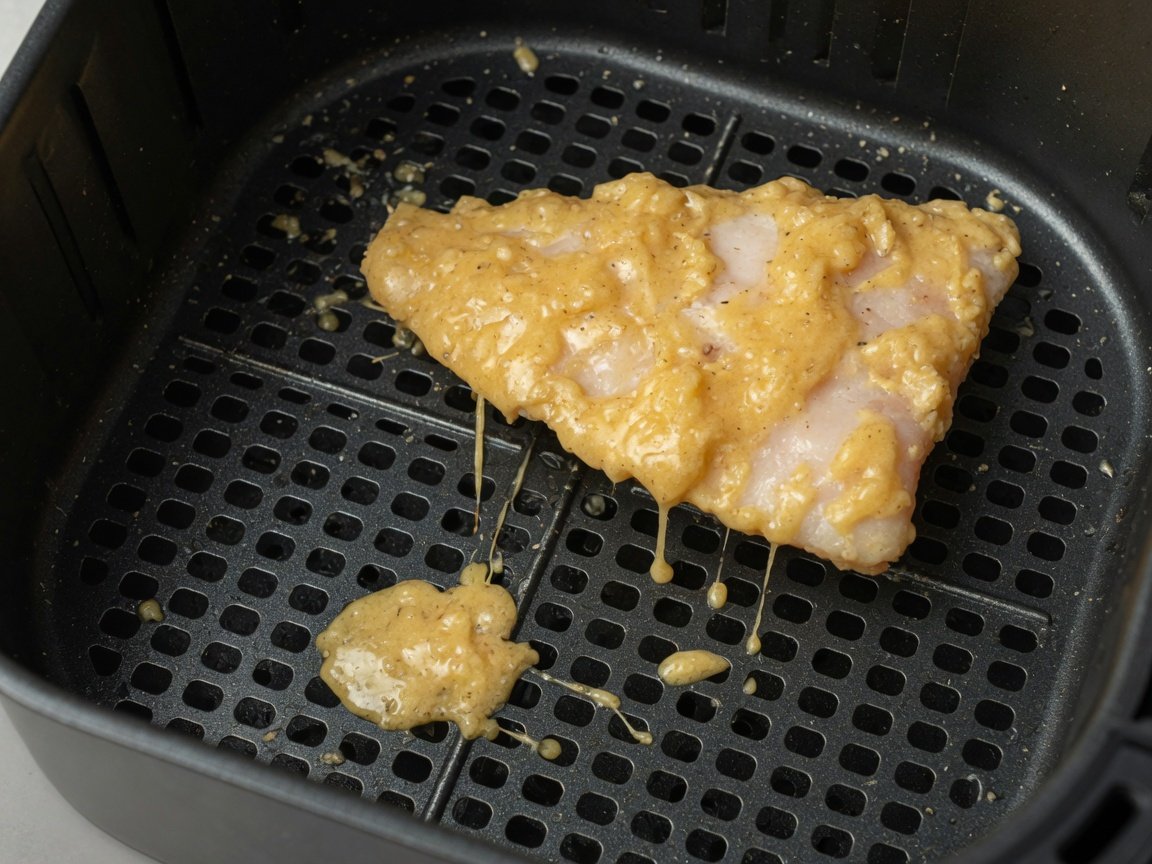
Food #1: Wet Runny Batter (Beer Batter, Tempura, Thick Liquid Dips)
This is almost certainly the most common air fryer mistake people make. You want crispy beer-battered fish — perfectly understandable. You dip the fillet, lower it into the basket, hit start. Within a couple of minutes, batter is dripping through the mesh grates, hitting the heating element, and producing thick, acrid smoke. The food ends up with a gummy, partially-cooked coating that peels off in strips rather than the golden, shattering crust you were after.
Here’s the physics: traditional deep frying works because the batter is surrounded by 350°F oil on every surface simultaneously. That oil flash-cooks the exterior from all sides in seconds, setting it into a rigid shell before it has any chance to slide or drip. In an air fryer, there’s no surrounding medium. The batter sits on top of the food, pulled down by gravity, blasted by hot air from above. The top surface might begin to dry — but the underside stays wet and runs. Food scientists describe this as an asymmetric heat-transfer problem: the batter can’t form a crust before the food beneath has released its surface moisture.
What to do instead: Use a three-stage dry coating — plain flour, then a beaten egg wash, then panko breadcrumbs. Panko has a coarser, flakier structure than standard breadcrumbs. It crisps up dramatically in the air fryer and produces a texture that is genuinely close to deep-fried. Spray lightly with cooking oil before and halfway through. Using perforated air fryer liners underneath breaded items catches loose crumbs and stray drips before they hit the basket surface, which makes clean-up significantly faster and protects the nonstick coating over time.
Food #2: Leafy Greens and Delicate Fresh Herbs
Spinach, lettuce, rocket, fresh basil, parsley — anything light and leaf-shaped has no business going into a basket air fryer without serious modification. The fan inside a standard air fryer moves air at high velocity to distribute heat evenly. That’s excellent for a chicken thigh. It’s a disaster for a handful of spinach, which weighs almost nothing. Leaves lift off the basket immediately, some land against the heating element and char within seconds, and the rest end up unevenly dried and bitter.
Kale chips are an exception — but they require a very specific approach. The kale must be completely bone-dry before it goes in (any surface moisture causes steaming rather than crisping), torn into evenly sized pieces, and cooked at a lower temperature — around 300°F rather than the standard 375–400°F. Some home cooks place a small metal cooling rack directly on top of the leaves to hold them down against the basket floor. Even then, smaller torn pieces will still migrate. This is a technique that works best with larger, sturdier leaves.
Dried herbs — rosemary, thyme, dried chilli flakes, oregano — are absolutely fine to add directly to food during air frying. They’re low in moisture and typically mixed into or pressed onto surfaces rather than sitting loose in the basket. Fresh herbs, without exception, should be added after cooking is complete.
Food #3: Popcorn Kernels
It seems like it should work. You have an enclosed heated space, a temperature range that overlaps with what popcorn needs, and a cooking chamber that’s broadly similar in concept to a microwave. But popcorn relies on a specific physical process that an air fryer actively undermines.
Each kernel contains a small amount of moisture locked inside a hard starch shell. When the kernel heats to around 347°F (175°C), that internal moisture turns to steam, pressure builds to approximately 135 psi, and the shell bursts — the gelatinised starch expands into the familiar white puff. Crucially, the moisture has to stay inside the kernel until that pressure threshold is reached. An air fryer’s high-speed circulating fan continuously wicks moisture from the surface of each kernel, preventing the internal pressure from building cleanly. Many kernels partially dehydrate at the surface before they pop — and they scorch rather than explode.
Some premium 2026 air fryer models include a lower-speed fan mode or a dedicated covered insert that can improve popcorn performance. But for a standard basket air fryer, popcorn is simply the wrong tool for the job. A microwave or a stovetop pan with a lid gives you better results in less time, with no mess and no equipment smell to deal with afterwards.
Food #4: Bare Cheese (Uncontained Slices or Soft Blocks)
Cheese in an air fryer can be genuinely brilliant — mozzarella sticks, halloumi skewers, parmesan-crusted chicken, baked camembert in a ramekin. The problem is bare cheese: a slice of cheddar on its own, a hunk of brie, a mound of grated cheese dropped directly into the basket with nothing to hold it in place as it melts.
Most soft and semi-soft cheeses begin melting at around 130–150°F. An air fryer reaches 300–400°F in under three minutes. The cheese turns to liquid almost instantly, runs through the basket grates, coats the drawer below, hits the heating element, and starts producing heavy smoke. High-fat cheeses like cheddar, brie, and raclette go this route very fast. Lower-moisture, higher-protein cheeses like halloumi or aged parmesan hold their structure considerably better under heat and can be air fried more safely.
The real long-term damage is to your basket coating. Baked-on burnt cheese is one of the most stubborn residues to remove from a nonstick surface. Scrubbing hard enough to remove it risks permanently stripping the coating — and a compromised basket surface means food sticks more readily, burns faster, and may eventually begin flaking material into your food. If your basket is already showing visible wear, it’s worth replacing rather than continuing to cook on it. The guide to the best nonstick air fryer baskets for 2026 covers the most durable, coating-safe replacements currently available.
Food #5: Raw Dry Grains (Uncooked Pasta, Rice, Whole Grains)
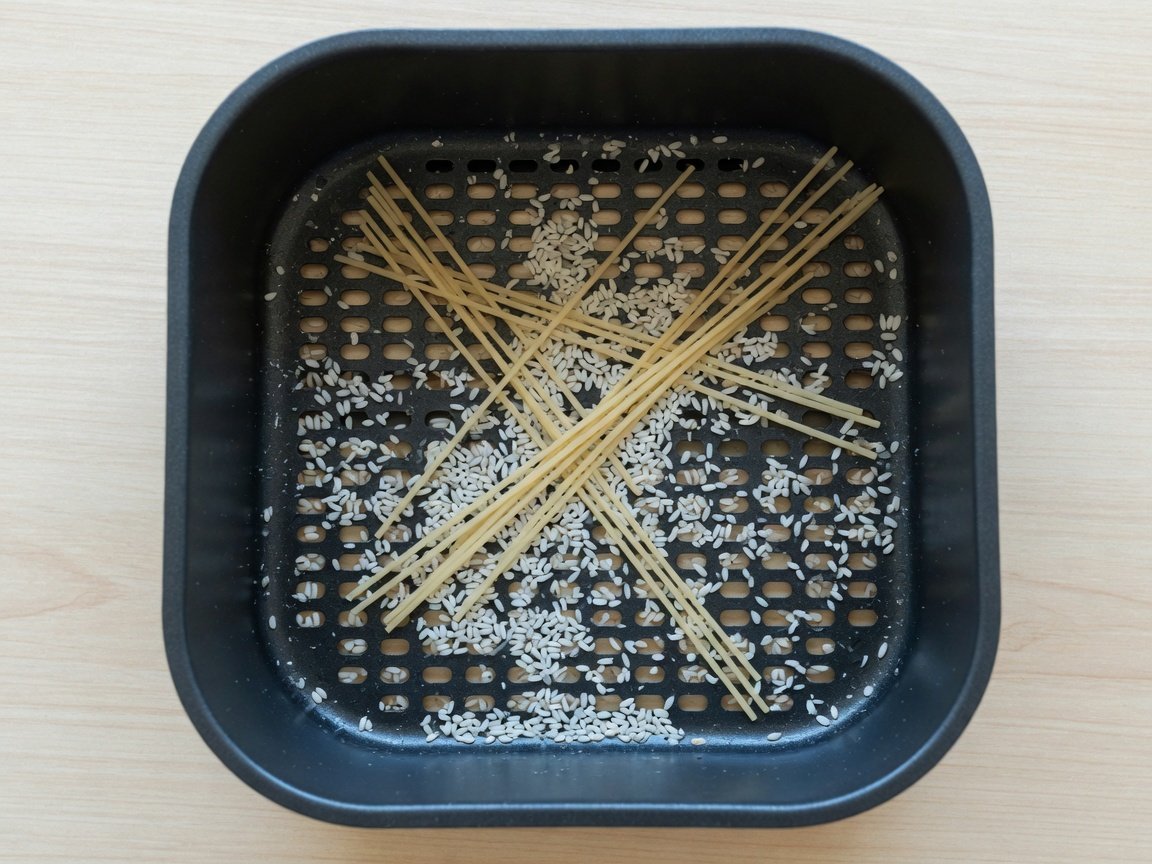
Raw pasta, uncooked rice, dry lentils, barley, and similar grains require one thing that an air fryer cannot provide: water. Cooking grains is a hydration process. The starch granules inside pasta and rice need to absorb liquid to gelatinise and become edible. Hot dry air — even at 400°F — supplies heat but no moisture. The result is exactly what you’d expect: warm, slightly darker, still completely raw and inedible grains.
Fine dried pastas like angel hair or vermicelli are especially problematic. The fan will pick up individual strands, fling them around the basket, and some will char against the element while others remain cool. You end up with a mixture of carbonised fragments and untouched raw pasta — and loose burnt strands embedded in the basket mesh that take time to clean out.
Pre-cooked grains are an entirely different matter. Leftover cooked and cooled rice crisps up excellently in the air fryer, producing a texture similar to good fried rice. Cooked pasta tossed in olive oil transforms into excellent pasta chips at 380°F in around 10 minutes. The rule is: grains need to be fully cooked — and well-drained or dried — before they go in. Raw is a hard no.
What Other Foods Need Special Handling in an Air Fryer?
Beyond the five hard-no foods, there are a handful of others that can cause problems if you treat them the same way you would a conventional oven. These aren’t off-limits entirely — they just need a modified approach.
| Food | What Goes Wrong | How to Fix It |
|---|---|---|
| Eggs in the shell | Pressure builds inside the shell; risk of cracking or bursting inside the unit | Crack into a ramekin or silicone cup — scrambled and fried eggs work well this way |
| Frozen foods with heavy ice glaze | Ice melts rapidly, causing a steam spike; excess water drips and creates smoke | Pat food dry and allow heavy ice glaze to thaw slightly before cooking |
| Very large whole cuts of meat | Outside chars before the interior reaches a safe temperature | Cut into smaller portions, lower the temperature, or use a higher-capacity model |
| Foods with heavy sugar glazes | Sugar caramelises and burns quickly at high temperature | Drop to 325°F, check every few minutes, and apply glaze only in the final 2–3 minutes |
| Thin white bread slices | Light slices lift and may contact the heating element | Use thicker-cut bread or hold flat with a small wire rack pressed on top |
If you’re frequently hitting capacity issues with large cuts of meat, a bigger-capacity model makes a measurable difference. The independently tested and ranked guide to the best large air fryers of 2026 covers which models distribute heat most effectively across larger portions — reducing the burnt-outside-raw-inside problem that affects smaller basket fryers with oversized cuts.
How Do You Protect Your Air Fryer Basket and Heating Element?
The most expensive air fryer repair is almost always the result of a preventable mess. Whether it’s burnt-on cheese, dripped batter, or grease accumulation from high-fat foods, most basket and element damage traces back to a handful of habits that are straightforward to change once you know them.
- Use perforated liners for anything saucy, cheesy, or prone to sticking. Parchment liners with holes allow airflow through while catching fat and food debris before it hits the basket surface.
- Never use metal utensils or abrasive scrubbers on nonstick surfaces. Even minor scratching accelerates coating degradation and creates sticky spots that compound over time.
- Clean after every use — at minimum, a five-minute wipe-down of basket and drawer. This prevents the grease build-up that causes smoke in subsequent cooking sessions.
- Check the heating element periodically. When completely cool and unplugged, wipe gently with a slightly damp cloth if you see browning or residue accumulating on the coil.
- Never plunge a hot basket directly into cold water. Thermal shock can warp the basket frame and compromise the nonstick coating’s adhesion over time.
If your air fryer has started producing more smoke than usual during normal cooking, that’s almost always built-up grease on the element rather than a mechanical fault. A structured air fryer troubleshooting checklist will help you identify whether the issue is a cleaning job or something that warrants a closer look at the hardware.
What Do Air Fryers Actually Excel At in 2026?
Knowing the limits makes the wins more valuable. Air fryers genuinely outperform conventional ovens in several specific categories — faster results, crispier textures, and more consistent browning on the right foods.
- Frozen foods: Chips, nuggets, fish fingers, spring rolls — the air fryer produces crispier results than an oven at roughly 30–50% of the time, in most cases faster than the packet guidance suggests.
- Chicken wings and thighs: High fat content bastes the meat as it cooks. Skin comes out genuinely crisp — consistently better than oven results without deep frying.
- Roasted vegetables: Broccoli, cauliflower, courgette, carrots, peppers — all excellent with a light oil spray, typically done in 12–18 minutes at 375°F.
- Reheating leftovers: Pizza, fried chicken, chips — returns to genuinely crisp rather than the soggy result of microwave reheating.
- Bacon: Faster than the hob, zero splatter, consistently even. Around 8 minutes at 375°F delivers excellent results.
If you’re choosing or upgrading an air fryer and want independent, tested comparisons rather than marketing claims, the AirFryerJunkie team has ranked the best air fryers of 2026 across cooking performance, capacity, ease of cleaning, and value — covering models at every price point.
How Is Air Fryer Technology Evolving Through 2026–2027?
Several of the limitations described in this article are actively being addressed at the hardware level as the category matures. A few developments are worth knowing about if you’re considering your next purchase.
- Steam-inject models: A growing number of 2026 releases include a small water reservoir that delivers a controlled burst of steam at the start of cooking before transitioning to dry hot air. This dramatically improves results with battered and doughy items — steam sets the exterior surface while the hot-air phase finishes the crisping. These hybrid appliances can handle recipes that previously required a dedicated steam oven or combi-microwave.
- Variable fan speed controls: Next-generation models are moving toward programmable fan speeds, which allow you to reduce airflow for delicate items — including some leafy vegetables and thin proteins — without dropping below effective cooking temperature. This directly addresses the “light foods fly around” problem.
- Improved ceramic and PTFE-free coatings: Nonstick coating durability has advanced meaningfully over the past two years. Current ceramic formulations are substantially harder and more heat-resistant than earlier iterations, handling occasional drips and stubborn residue more gracefully and cleaning up with less effort.
- Dual-zone cooking: Dual basket models running independent time and temperature profiles in each zone have gone mainstream in 2026. This opens up meal prep combinations that previously required multiple appliances running in sequence, and reduces total cooking time significantly for full meals.
Frequently Asked Questions About Foods and Air Fryers
Can you put aluminium foil in an air fryer?
Yes, in limited amounts. A small sheet of aluminium foil can be placed in the basket to catch drips or line a section of the base — but you should never cover the entire basket floor or block the ventilation holes underneath. Blocking those vents prevents hot air from circulating and produces uneven cooking or, in some models, overheating. Also avoid foil in contact with acidic foods like tomatoes, citrus, or vinegar-based marinades, as the acid can cause metallic leaching into food.
Is it safe to cook raw meat in an air fryer?
Absolutely. Air fryers easily reach the temperatures needed to kill foodborne bacteria, and they’re safe for raw chicken, beef, pork, and fish. Always verify internal temperature with a probe thermometer rather than relying on time alone: 165°F / 74°C for chicken, 145°F / 63°C for beef and fish (with a three-minute rest for pork). Thick cuts can look done on the outside while remaining undercooked in the centre — the probe removes that guesswork entirely.
Why does my air fryer produce so much smoke during cooking?
Smoke almost always indicates grease build-up on the heating element or in the drawer below the basket. Even a thin film of old fat from previous cooks will smoke at temperature. Clean the basket, the drawer, and the interior of the unit regularly. If smoking continues after a thorough clean, the food you’re cooking may be producing more drip than usual — fatty cuts like pork belly, streaky bacon, or skin-on duck thighs generate significant fat runoff. Adding a tablespoon of water to the drawer beneath the basket before cooking high-fat foods helps cool the drips before they smoke.
Can you put glass or ceramic dishes inside an air fryer?
Oven-safe glass and ceramic can generally be used, provided the container fits without blocking airflow around the sides of the basket. Confirm the dish is rated to at least the temperature you’re cooking at. Thin glass or anything not explicitly marked oven-safe is a risk — rapid high heat can cause it to crack or shatter. Small ramekins, oven-safe ceramic bowls, and silicone baking cups are the most reliable options for containing eggs, sauces, or melting cheese inside a basket air fryer.
Does an air fryer need to preheat before cooking?
For most foods, a two-to-three minute preheat improves results noticeably. A hot basket means food starts cooking on contact rather than slowly coming up to temperature from cold — the difference is most visible on anything you want a genuinely crispy exterior on. Most modern air fryers reach operating temperature within two to three minutes, so the time cost is minimal. For gentle reheating or lower-temperature cooking, preheating is less critical but still doesn’t hurt.
What happens when you overfill the air fryer basket?
Overcrowding is one of the most consistent reasons air-fried food comes out disappointing. When food is stacked on top of itself, hot air can’t circulate freely around each piece — you get steamed food rather than crispy food. Research into hot-air convection cooking shows that restricting airflow by 40–50% or more significantly reduces the surface heat transfer responsible for crisping. As a practical rule, fill the basket to no more than two-thirds capacity and leave visible gaps between pieces wherever possible. Batch cooking adds a few minutes to your total time but produces consistently better results across every piece.
The Simplest Rule: Work With the Hot Air, Not Against It
An air fryer’s entire mechanism depends on hot, dry, circulating air reaching all surfaces of your food evenly and rapidly. Every problem food on this list works against that mechanism in a specific way — too wet, too light, too large, needs moisture to cook, or melts before it can hold its shape. Once you understand the mechanism, the no-go list stops feeling arbitrary and starts feeling intuitive.
Before cooking anything new, run through this five-question check:
- Is it wet or runny? If yes, contain it in a ramekin or switch to a dry breadcrumb coating.
- Is it very light or leaf-shaped? If yes, weigh it down or add it fresh after the food comes out.
- Does it need water to cook? If yes, it doesn’t belong in the air fryer unless it’s already been cooked.
- Will it melt and drip heavily? If yes, use a liner or a small oven-safe cup to contain it.
- Is it too large for hot air to reach the centre? If yes, cut it into smaller portions or consider a higher-capacity model.
Five questions, thirty seconds — and you’ve avoided the most common air fryer disasters before they start.
