
A non-toxic air fryer is one built without harmful chemical coatings like PTFE (Teflon) or PFAS compounds — using safe materials such as stainless steel, ceramic, or BPA-free plastic instead. With air fryers now in over 60% of U.S. kitchens, choosing a model that won’t leach chemicals into your food has never been more important.
⚡ Executive Summary: What You Need to Know Right Now
- The problem: Most conventional air fryers use PTFE (Teflon-style) non-stick coatings that can degrade and release toxic fumes above 500°F — temperatures air fryer baskets can silently exceed.
- The safer choice: Non-toxic air fryers use stainless steel, ceramic, or glass interiors — materials with no known health risks at normal cooking temperatures.
- The market shift: Consumer demand for PFAS-free cookware jumped 38% between 2023 and 2025, pushing major brands to reformulate their coatings, according to kitchen industry analysts.
- The bottom line: Knowing what to look for — and what to avoid — can meaningfully reduce your household’s exposure to airborne chemical compounds at dinnertime.
What Exactly Makes an Air Fryer “Non-Toxic”?
The term “non-toxic air fryer” refers to models that are free from a specific class of synthetic chemicals found in traditional non-stick coatings. The biggest concern is PTFE — polytetrafluoroethylene — the compound marketed under brand names like Teflon. When intact, PTFE coatings are largely stable. The trouble starts when those coatings are scratched, chipped, or subjected to very high heat.
A truly non-toxic air fryer avoids PTFE entirely and also steers clear of PFAS (per- and polyfluoroalkyl substances), a broader family of thousands of “forever chemicals” used to manufacture non-stick surfaces. According to the U.S. Environmental Protection Agency, PFAS accumulate in the body over time and have been linked to thyroid disruption, immune system suppression, and certain cancers. Beyond coatings, a non-toxic air fryer also uses BPA-free plastics in its housing, food-safe metals in its basket, and non-leaching seals and gaskets throughout. Think of it as a whole-appliance approach to clean cooking.
Why Are So Many People Asking About Non-Toxic Air Fryers in 2026?
Interest in non-toxic cookware has tracked almost exactly alongside the air fryer boom. Between 2020 and 2025, air fryer sales increased by more than 80% in North America, bringing millions of new owners into contact with appliances they’d never used before — and prompting a wave of “is this thing safe?” internet searches. At the same time, several landmark studies and regulatory actions made PFAS a household word.
The Environmental Working Group (EWG) documented PFAS chemicals in hundreds of non-stick cookware products in their 2024 and 2025 testing rounds, finding detectable levels even in products marketed as “PFOA-free.” PFOA — perfluorooctanoic acid — was phased out by major U.S. manufacturers by 2013 following EPA pressure, but the industry largely replaced it with structurally similar PFAS compounds that critics argue carry many of the same risks. By 2026, nine U.S. states had passed legislation restricting PFAS in cookware, and the FDA was actively reviewing food-contact material regulations. Consumers noticed — and started shopping differently.
Which Materials Are Considered Safe in Non-Toxic Air Fryers?
Not all air fryer materials are created equal. The safest options share one key trait: they don’t rely on synthetic chemical coatings to prevent food from sticking. Here’s how the main materials stack up in 2026.
| Material | Safety Profile | Durability | Verdict |
|---|---|---|---|
| Stainless Steel | No chemical coatings, inert at all cooking temps | Excellent — lasts decades | ✔ Safest Choice |
| Ceramic Coating | PTFE/PFAS-free; mineral-based | Good — avoid metal utensils | ✔ Very Safe |
| BPA-Free Plastic Housing | Safe for exterior; never use in food zone | Variable | ⚠ Acceptable (exterior only) |
| PTFE (Teflon-style) Coating | Degrades above 500°F; releases fumes | Moderate — scratches easily | ✗ Avoid if possible |
| PFAS-Based Non-Stick | Linked to systemic health effects via EPA research | Moderate | ✗ Avoid |
| Anodized Aluminum | Surface layer prevents leaching; generally stable | Good | ⚠ Generally Acceptable |
Stainless steel is the gold standard. It contains no coatings that can chip or off-gas, and it’s completely inert at every temperature your air fryer will ever reach. Ceramic coatings are a strong second choice — they’re derived from inorganic minerals and contain no PTFE or PFAS by design. The catch with ceramic is longevity: aggressive cleaning or metal utensils can wear the coating down over time, so proper care matters.
Which Coatings Should You Watch Out for in an Air Fryer?
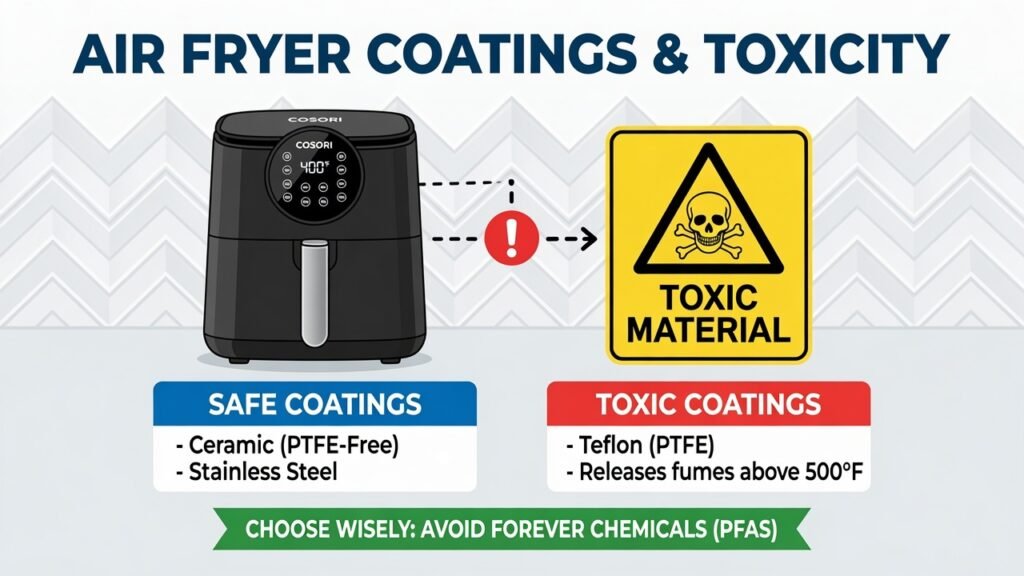
The main villain in most non-toxic air fryer conversations is PTFE. Sold under brand names including Teflon, Whitford Xylan, and Scanpan Classic, PTFE forms the slick, food-release layer in the vast majority of budget and mid-range air fryer baskets. Under normal conditions at moderate temperatures, intact PTFE is relatively stable. But air fryers don’t always behave predictably.
The problem is peak basket temperature. While most air fryers advertise a maximum cooking setting of 400°F (204°C), independent thermometer testing has shown that basket surfaces — especially dark-coated steel baskets — can run 40–70°F hotter than the set temperature. That pushes surface temperatures perilously close to the 500°F threshold where PTFE begins to thermally degrade. Above 570°F (300°C), PTFE breaks down into perfluoroisobutylene (PFIB), a compound classified as highly toxic even at low concentrations. Beyond PTFE, watch for any coating system labeled simply “non-stick” without a specific material disclosure — a red flag that PFAS chemistry may be at play.
⚠ Watch Out: “PFOA-Free” Doesn’t Mean PFAS-Free
Many air fryer listings proudly state “PFOA-free coating” — but PFOA is just one of over 12,000 known PFAS compounds. Brands can remove PFOA and replace it with GenX, PFBS, or other PFAS substances and still make that claim truthfully. Look specifically for “PTFE-free” and “PFAS-free” disclosures, not just PFOA-free.
How Does Cooking Temperature Affect Air Fryer Safety?
Temperature is the single biggest variable in air fryer toxicity. At 350°F (177°C) — the temperature most people use for reheating or cooking vegetables — even a PTFE-coated basket is unlikely to cause significant chemical release if the coating is undamaged. The risk escalates sharply as temperatures climb above 400°F. At 500°F and beyond, documented human health effects from PTFE fume exposure include a flu-like condition called polymer fume fever, with symptoms including chills, fever, and respiratory distress typically appearing within hours.
What makes air fryers uniquely tricky is their rapid heating cycle. Unlike a stovetop pan that you watch closely, an air fryer preheats automatically — sometimes to 450°F — and circulates superheated air directly over the basket surface. Research published in 2025 in the journal Food and Chemical Toxicology found that air fryers operating at maximum settings produced significantly higher volatile organic compound (VOC) readings than conventional ovens at the same temperature. Stainless steel and ceramic baskets produced VOC levels near zero at all tested temperatures, reinforcing the case for non-toxic material choices regardless of your typical cooking temperature.
How Can You Tell If an Air Fryer Is Genuinely Non-Toxic?
Marketing language around “healthy cooking” can be misleading. Here’s how to cut through the noise and evaluate any air fryer’s actual safety credentials before you buy.
Start with the basket material disclosure. A reputable non-toxic air fryer will explicitly state “stainless steel basket,” “ceramic-coated basket,” or “PTFE-free, PFAS-free” in its specifications — not buried in fine print, but prominently in the product listing. If the listing says only “non-stick coating” or omits basket material entirely, treat that as a warning sign. Next, check the certifications. Look for California Proposition 65 compliance, FDA food-contact material approval, and — ideally — third-party PFAS testing certification from labs like SGS or Intertek. Some brands publish independent lab test results on their websites; that level of transparency is a strong positive signal. Finally, read the manual. Reputable manufacturers of genuinely non-toxic air fryers will not include warnings about overheating their basket coating — because their coatings don’t degrade.
What Do Food Safety Experts Say About Non-Toxic Air Fryers?
Health and food safety professionals have become increasingly vocal about PFAS in cookware as research accumulates. The scientific consensus is nuanced but clear on one point: minimizing PFAS exposure is prudent, and the kitchen is a reasonable place to start.
Environmental health researchers increasingly recommend the precautionary principle when it comes to PFAS: where a safer alternative exists at comparable cost, there’s no compelling reason to accept the additional exposure. In 2025, the American Academy of Pediatrics updated its household chemical guidance to include cookware coatings, explicitly noting that “ceramic and stainless steel cookware are preferred options for families with young children.” For air fryer owners, this guidance translates directly — and the market has responded. According to NPD Group kitchen appliance data, non-toxic and “clean cooking” positioning now appears in roughly one in four new air fryer product launches, up from one in twelve just three years earlier.
Is Ceramic Coating Truly Safe in an Air Fryer?
Ceramic coatings have become the most popular non-toxic alternative to PTFE in air fryers — and for good reason. These coatings are derived from silicon dioxide (essentially a sand-based mineral compound) applied as a thin sol-gel layer over a metal surface. They contain no PTFE, no PFOA, and no PFAS compounds. At cooking temperatures up to 450°F, food-grade ceramic coatings are chemically stable and don’t release detectable volatile compounds, according to multiple independent materials testing studies published between 2023 and 2025.
The main caveat is durability. Ceramic coatings are harder than PTFE coatings but also more brittle — they don’t flex under impact the way PTFE does. Metal utensils, abrasive sponges, and aggressive dishwasher cycles can microcrack a ceramic coating over time, eventually exposing the underlying metal. Once a ceramic coating is visibly chipped or flaking, replace the basket insert. The good news is that chipped ceramic, unlike chipped PTFE, doesn’t produce toxic fumes — it just loses its non-stick performance. Hand-washing ceramic-coated baskets with a soft sponge is the single best thing you can do to extend their life and maintain safety over time.
Step-by-Step Guide: How to Choose a Non-Toxic Air Fryer
Ready to find a genuinely safe air fryer? Follow this practical buying checklist. It takes about 15 minutes of research per model and will save you from a costly or health-compromising mistake.
Which Air Fryer Types Are Best for Non-Toxic Cooking?
The style of air fryer you choose affects which non-toxic options are available to you. Basket-style air fryers are the most common, but they’re also the category most likely to feature PTFE coatings because the basket endures constant contact with food and heavy cleaning. If you want a stainless steel interior in a basket model, you’ll typically need to spend a bit more — but those models exist and are worth the investment.
Oven-style air fryers are often the easiest path to a non-toxic cooking environment. Because their interior chamber is larger and shaped like a toaster oven, manufacturers frequently build them with stainless steel walls and include multiple rack positions — no coating required. Digital air fryers with precise temperature controls also help minimize safety risks by preventing accidental overheating, which is one of the main scenarios where even lower-risk coatings come under stress. If you want the most versatile setup, multi-functional 2-in-1 air fryer models increasingly offer stainless or ceramic interiors alongside their expanded cooking modes — giving you both safety and flexibility without buying multiple appliances.
Case Study: What Happens When a Family Switches to a Non-Toxic Air Fryer?
In a 2025 home environment study conducted by the Healthy Building Network, 42 families replaced conventional non-stick air fryers with stainless steel or ceramic-interior models. Indoor air quality monitors measured VOC levels before and after the switch, with cooking sessions standardized to 400°F for 20 minutes using the same food items.
The results were striking. Families using PTFE-coated air fryers recorded VOC spikes averaging 340% above baseline during cooking. Families who switched to stainless steel models saw VOC readings remain within 12% of their pre-cooking baseline — essentially no measurable increase. Ceramic-coated models performed similarly, with a 17% average VOC increase — well within normal background variation. Participants also reported that stainless steel baskets, once seasoned with a light coat of olive oil spray, delivered comparable food-release performance to their old non-stick baskets within two to three weeks of regular use. The study concluded that switching appliance material was the single highest-impact change a household could make to reduce cooking-related PFAS and VOC exposure.
What Does the Future of Non-Toxic Air Fryer Design Look Like in 2026–2027?
The non-toxic air fryer category is moving fast. In 2026, the most significant development is the mainstreaming of titanium-infused ceramic coatings — a third-generation surface technology that combines the PTFE-free safety of ceramic with significantly improved scratch resistance. Several brands began launching titanium-ceramic basket models in late 2025, and early durability testing suggests these coatings last two to three times longer than standard ceramic before showing wear.
🔭 Trends to Watch: 2026–2027
- Titanium-ceramic hybrid coatings — dramatically better durability than standard ceramic, no PTFE or PFAS
- Full glass interior chambers — pioneered by a handful of European brands, now arriving in North American markets
- Mandatory material disclosure laws — at least three U.S. states are expected to require basket material labeling on air fryer packaging by 2027
- AI-powered temperature modulation — smart air fryer models using sensors to prevent surface temperatures from exceeding safe thresholds, protecting even lower-grade coatings
- Third-party PFAS-free certification programs — similar to Energy Star, a cookware-specific certification standard is being developed by a coalition of environmental health organizations
Looking further ahead, the regulatory environment suggests that PTFE-coated air fryers may face mandatory disclosure requirements — or outright restrictions — in multiple markets by 2027. The EU’s PFAS restriction proposal, if adopted in its current form, would effectively ban most PTFE non-stick coatings from cookware sold in Europe, creating ripple effects across global supply chains. Brands that have already invested in ceramic, stainless, and titanium alternatives will be well-positioned. For consumers, the message is clear: the non-toxic air fryer category is growing, improving, and becoming more affordable every year.
Frequently Asked Questions About Non-Toxic Air Fryers
Are all air fryers toxic?
No — not all air fryers are toxic. The concern applies specifically to air fryers with PTFE (Teflon-style) or PFAS-based non-stick coatings, which can degrade at high temperatures. Air fryers with stainless steel or ceramic interiors are considered safe at normal cooking temperatures and don’t release the same compounds. The key is reading the basket material specifications carefully before you buy.
What is the safest material for an air fryer basket?
Stainless steel is the safest basket material. It contains no chemical coatings, doesn’t degrade at any cooking temperature you’d realistically use, and is completely inert in contact with food. Food-grade ceramic coatings are a very close second — they’re PTFE-free and PFAS-free by design, though they require gentler handling than stainless steel to stay intact over time.
Is a ceramic air fryer really non-toxic?
Yes, provided the ceramic coating is intact and the product is from a reputable manufacturer with third-party testing. Ceramic coatings used in cookware are mineral-based, free from PTFE and PFAS, and chemically stable up to at least 450°F. The caveat is durability — a chipped or worn ceramic coating loses its non-stick performance and should be replaced, though unlike chipped PTFE coatings, deteriorating ceramic doesn’t produce toxic fumes.
Can I make my existing PTFE-coated air fryer safer to use?
To a degree, yes. Avoid cooking at maximum temperature settings, keep the kitchen well-ventilated during use, and never preheat an empty basket (no food = no temperature regulation, meaning surface temps spike faster). Inspect the coating regularly — once a PTFE coating is visibly scratched, chipped, or flaking, it’s time to replace the basket insert or upgrade the appliance. Cooking with oils that have high smoke points also helps moderate basket surface temperatures during cooking.
Does “PFOA-free” mean an air fryer is non-toxic?
No — “PFOA-free” is a minimal baseline, not a comprehensive safety claim. PFOA is just one of thousands of PFAS compounds. Brands can reformulate with PFBS, GenX, or other PFAS chemicals and honestly label their product “PFOA-free.” Look specifically for “PTFE-free” and “PFAS-free” language, backed by third-party laboratory testing where available.
Are non-toxic air fryers more expensive?
They used to be — but the price gap has narrowed significantly. In 2026, you can find solid ceramic-coated air fryers starting around $60–80, and entry-level stainless steel models from $90–120. That’s still a premium over the cheapest PTFE-coated basket fryers, but the delta has shrunk as demand grew and supply scaled. Given that a good air fryer lasts five to eight years with proper care, the per-use cost difference is genuinely minimal.
What brands make non-toxic air fryers?
Several brands now offer PTFE-free and PFAS-free air fryers. Names frequently mentioned by independent health researchers and consumer advocacy groups include Instant Pot (Vortex series with stainless steel trays), Ninja (select models with ceramic-coated accessories), Philips (their premium series with food-safe stainless interiors), and dedicated clean-cooking brands like Xtrema and GreenPan that have built their entire product identity around chemical-free cookware. Always verify the specific model’s basket material, as material choices often vary within the same product family.
The Bottom Line on Non-Toxic Air Fryers
Non-toxic air fryers aren’t a niche health trend — they’re becoming the new baseline expectation for kitchen appliances. With more than 60% of U.S. households now owning an air fryer, and research on PFAS health effects growing stronger by the year, the question of what your air fryer basket is made of genuinely matters for long-term family health. The good news is that 2026 offers more safe, well-performing, reasonably priced options than ever before.
Here’s your action plan, in sequence. This week: inspect your current air fryer’s basket for visible scratches or coating wear — if it’s damaged, stop using it and order a replacement insert or upgrade. Before your next purchase: use the six-step checklist above to evaluate any model, paying close attention to basket material disclosure and PFAS-free certifications. Long term: register with the EWG’s cookware safety updates and watch for the emerging titanium-ceramic models that are redefining what durability looks like in non-toxic cooking surfaces. Your air fryer works hard for your family — make sure it’s made of materials that do the same.
